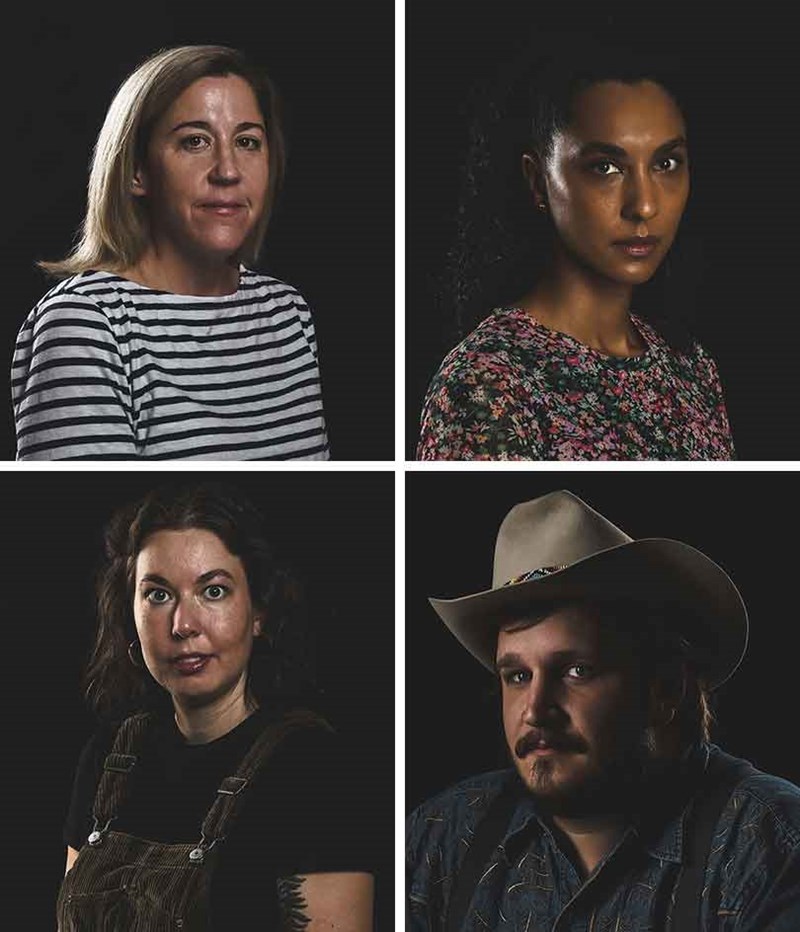
Clockwise from top left: Jane Blunschi, Robin Bruce, Willi Carlisle and Karstin Johnson.
Mid-America Arts Alliance has announced the recipients of the 2021 Artists 360 Awards. Two current graduate students and two alumni of the M.F.A. Program in Creative Writing and Translation in the Department of English have been awarded project grants. Their proposed projects focus on poetry, prose and podcasting/media.
Artists 360, a program of Mid-America Arts Alliance, made possible through the support of the Walton Family Foundation, is a three-year pilot program that provides grant funding and professional development opportunities to individual artists of all disciplines in the greater Northwest Arkansas area.
Grants include learning opportunities to develop entrepreneurial skills and build sustainable careers, creating a network of leading regional artists.
M.F.A. Program in Creative Writing and Translation student and alumni recipients of project grants are:
First-year M.F.A. student and poet Robin Bruce will develop Songs for Gordon, a scored audiobook based on her manuscript of poetry and essays, Dear Gordon, using a variety of instrumentation including cello, classical guitar, piano and singing.
Fourth-year M.F.A. student Karstin Johnson, who writes of her work in poetry, "Each poem I write inherently protests the marginalization of the arts. In a patriarchal society that sees women as inferior, resisting patriarchal conventions through writing is revolutionary."
Elizabeth Muscari
Jane Blunschi ('16) will complete work on Stigmata, Specifically, a collection of essays in which the role of queerness and spirituality in the formation of identity is explored, with pieces focused on body image, addiction, sobriety, fertility, marriage and divorce.
Willi Carlisle ('15) will produce A Folksinger's Almanac, a series of podcasts and live performances featuring field recordings, interviews and folksongs from Arkansas and around the world. A Folksinger's Almanac will focus on rural, queer and outsider voices.
In addition to this year's award winners, Artists 360 recognized the outstanding finalists for student grants, including second-year poet Elizabeth Muscari.
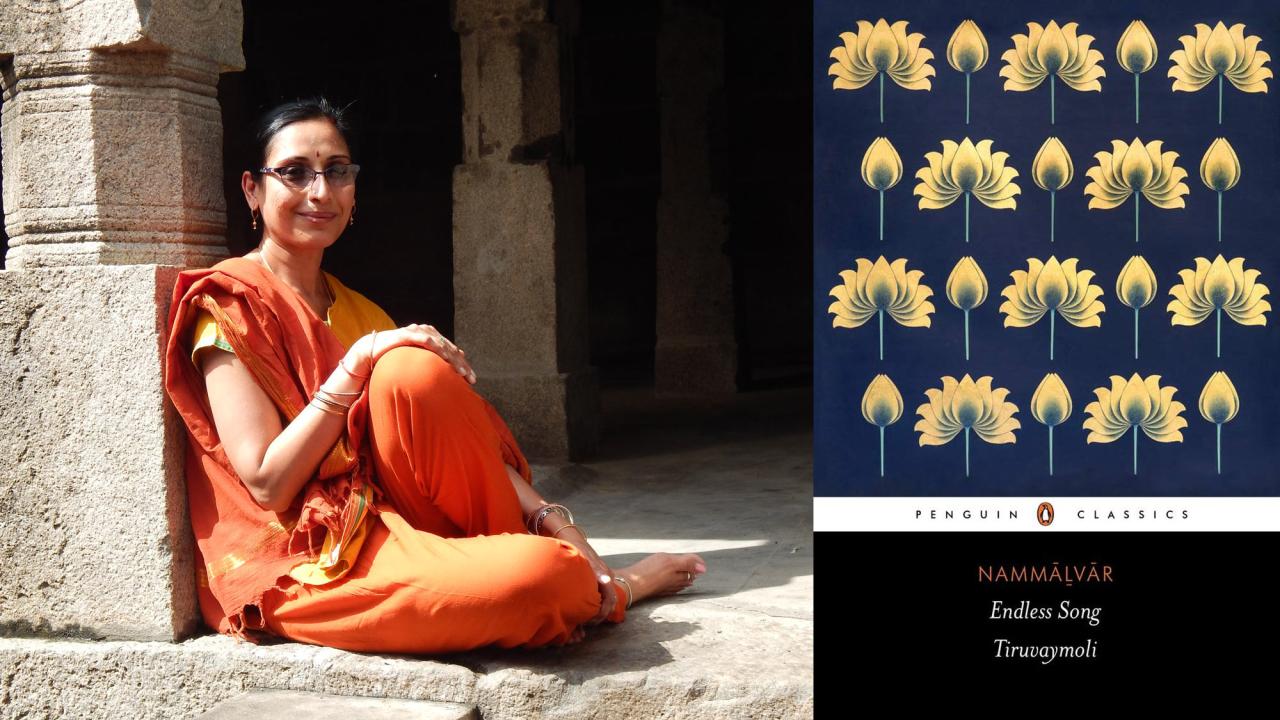
Opus by the ninth-century Tamil poet Nammāḻvār, translated into English by Archana Venkatesan, professor, departments of Religious Studies and Comparative Literature
Penguin Random House India (February 2020)
With [this volume] Venkatesan has clearly become the leading English interpreter of early Tamil Vaishnava lyric, and certainly one of the very few truly gifted translators of the language’s premodern riches. — Whitney Cox,associate professor of South Asian languages and civilizations, University of Chicago, writing in The New York Review of Books: “Lovesick for a God,” May 27, 2021
In one of India's most revered ancient bhakti poem, Tiruvāymoḻi, an epic Tamil work from the ninth century, Nammāḻvār sings of his ecstatic devotion to God. Twelve centuries later, this important text sings in English, too, thanks to UC Davis Professor Archana Venkatesan’s translation.
So said the judges who earlier this month named her “monumental” work, Endless Song, as the winner of the 2021 Lucien Stryk Asian Translation Prize. The $6,000 award is from the American Literary Translators Association.
Professor Venkatesan displays her prize-winning book.
Venkatesan has a dual appointment in the departments of Religious Studies and Comparative Literature, and writes about her work on her website and blog, “Poetry Makes Worlds: On Tamil, Temples and Translations.”
In a post after her win, she wrote: “I am shocked, elated, humbled and honored by this recognition. It took a very long time to birth this book, to find an English to match the soaring heights of Nammāḻvār’s Tamil.”
“A very long time” started in 2007 for a project encompassing 1,102 interlinked verses described by the publisher as “a garland of words where each beginning is also an ending.” A challenge, yes, but a true labor of love for someone like Venkatesan who translates almost every day.
“This is a discipline I maintain,” she said in an interview with Dateline UC Davis for this books blog post. “It’s what keeps me grounded as it infuses beauty and magic into my every day. Usually, I translate a single verse or one short poem. I tinker with it until I feel that click, this intangible sense when the words make sense in English.
“For Endless Song, translating a verse would require reading not just the verse but the commentaries from over the centuries, so it was very slow, painstaking, but joyous work.”
A work of art
Venkatesan described the Tiruvāymoḻi as “wonderful, intoxicating poetry” and added: “My hope is always that more people will discover the wonders of Tamil literature.”
Endless Song, published in February 2020, can certainly help. Whitney Cox, associate professor of South Asian languages and civilizations at the University of Chicago, writing in The New York Review of Books, said Venkatesan’s translation allows readers to take in Nammālvār’s work in its entirety, as she goes beyond the theology to present his poetry as art.
VERSE I.1.5
Each knows what they know,
each finds a different path
Each has their god
each reaches his feet
Each of these gods lacks nothing,
everyone is fated
to find their way to the great lord
who’s always there.
The judges of the American Literary Translators Association said she had “crafted a translation that one can experience not only as a well-annotated, definitive work of scholarship, but also as a living, breathing work of contemporary poetry.”
The Lucien Stryk Asian Translation Prize, named after the American poet who translated Buddhist literature and Zen poetry, and first given in 2009, recognizes the importance of Asian translation for international literature and promotes the translation of Asian works into English.
Endless Song is the first South Asian literary work to win the prize and Venkatesan is the first person of South Asian descent to win it.
The award ceremony took place virtually, Oct. 16. Venkatesan chatted with Anne O. Fisher, vice president of the American Literary Translators Association, then gave a reading.
Poetry is her anchor
Venkatesan officially joined the UC Davis faculty in 2007, the year she started her Tiruvāymoḻi translation, but she did not arrive on campus until 2008, after a research leave on fellowships from the National Endowment for the Humanities and the American Institute of Indian Studies.
VERSE IV.3.8
You’ve entered my breath,
radiant light of wisdom
filling the seven beautiful worlds.
My breath is yours
Your breath is mine
I can’t describe how this is
I can’t describe the way you are.
•••
Read more excerpts.
She served as the religious studies chair from 2015 to 2018, took a one-year sabbatical, then served as chair again from 2019 to 2021. She is also affiliated with the Art History Program and the Graduate Group in Performance Studies. She was a Chancellor’s Fellow from 2014 to 2019.
She came to California from Madras, India, at age 18, studied two years at De Anza community college in Cupertino, then transferred to UC Berkeley where she earned a bachelor’s degree in English literature, and a master’s degree and doctorate in South Asian studies.
“My graduate work took me back to India, a place I knew, but yet had to relearn,” she says on her website. “Poetry remained my anchor through it all. I learned to translate and realized that it was the instrument to understand, perhaps even reconcile, my twin souls — one nurtured in India and another nourished in the U.S.”
She works primarily in early-medieval Tamil, translating from Tamil to English. “I also work with a commentarial language that is a mixture of Tamil and Sanskrit called Manipravala (literally, gems and coral),” she said.
Other works
Besides Endless Song, she has published A Hundred Measures of Time, her translation of Nammāḻvār’s 100-verse Tiruviruttam; and The Secret Garland, her translation of Āṇṭāḷ’s Tiruppāvai and Nācciyār Tirumoḻi, two of the most significant compositions by the ninth-century female poet and mystic Kōtai.
Venkatesan is working now as the director and co-editor ofThe Kampaṉ Projectin which she and six others are translating the 12th-century Rāmāyaṇa from Tamil to English. She is translating Book 5, “Sundara Kāṇḍam” (Loveliness).
She is a member of the editorial board of the project sponsor, the Murty Classical Library of India, an imprint of Harvard University Press.
Another of her projects is “Poetry Makes Worlds,” on the annual Festival of Recitation (Adhyayanotsavam), supported by a fellowship from the Guggenheim Foundation (2018) and a Fulbright Flex Award (2017-19).
Additionally, she and three other scholars are studying the Nava Tirupati, a network of nine Vishnu temples along the Tamiraparani river. and extolled in Nammāḻvār’s poetry. “Our project,” she says on her website, “is a study of how temple networks are constituted, how these temples dialog with their built environment, and the very important business of making heaven on Earth.”
The UC Davis Books Blog, a project of News and Media Relations, announces newly published books by faculty and staff authors, and awards and events related to books by faculty and staff authors. Contact the books blog by email.
IU’s Lilly Library has taken possession of book collector Madeline Kripke’s wide-ranging dictionary collection, according to an IU News article. Kripke, also known as the “Dame of Dictionaries,” collected more than 20,000 linguistic books in her lifetime.
Kripke kept the books in her apartment in New York City until her death in April 2020, according to the article. One of her dying wishes was to create a public dictionary library, leading to IU gaining ownership after her passing.
Michael Adams, provost professor and chair of the department of English in the College of Arts and Sciences, met Kripke through the Dictionary Society of North America, according to the article. After Kripke’s death, Adams reached out to the Lilly Library Director Joel Silver to begin acquiring her large dictionary collection.
"It was of primary importance to the community of dictionary people that the collection stay together," Adams said in the article. "But we knew Madeline would have wanted the collection to end up at a public university, where all the very rarest materials would be available to everyone."
At this time, only a third of the collection, 6,000 volumes, from the Kripke collection have been inventoried at the Lilly Library.
"We're very pleased to be able to preserve Madeline Kripke's remarkable collection here at the Lilly Library," Silver said in the article. "We'll always be grateful for her unrivaled knowledge and dedication, which enabled her to assemble this matchless resource.”
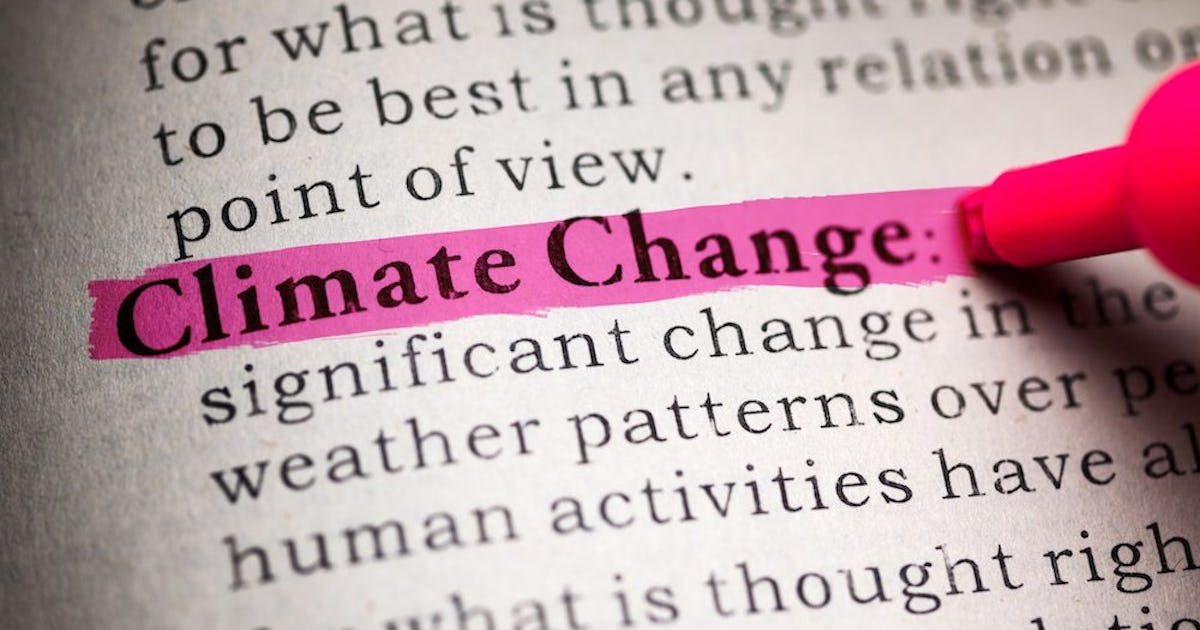
Climate change has become an increasingly common topic of conversation, and the Oxford Dictionary knows it. In a special update issued in advance of the United Nations Climate Change Conference (COP26) set to be held later this month in Glasgow, Scotland, the principal historical dictionary of the English language has added a handful of climate- and sustainability-related terms to its official pages.
There are more than 48 new entries and sub-entries, as well as 28 new tenses and other additions, all related to conversations about the climate. Terms like “CO2” have been added, as well as “climate crisis,” which was added as a sub-entry for climate and defined as “the increasing risk of hazardous, irreversible changes to the climate, resulting from global warming; the environmental crisis arising from this risk.”
The new terms are reflective of the moment. Additions like “climate action” and “climate strike” help to provide language for how activists, environmentalists, and many others have responded to the increasingly dire crisis. Meanwhile, language like “global heating” (“an increase in the average temperature of the Earth's atmosphere, waters, and land surface; the long-term gradual temperature increase occurring in the wake of the Industrial Revolution”) and “extreme weather” (“weather that is very harsh, unseasonal, or atypical for a particular region, (now) especially when attributed to the effects of climate change”) give us the ability to clearly name what is happening to the planet. The fact that the definitions do not shy away from connecting the dots to climate change adds a sense of certainty: This is happening, and it is because of climate change.
Oxford also took on new terms that speak to the aspirations that we should collectively have if we want to keep the planet in a livable state. The pages of the dictionary will now include “decarbonization,” defined as “the action or process of reducing or eliminating the fossil fuel use of an economy, business sector, etc., so as to reduce carbon dioxide emissions.” Likewise, the long-term goal of net-zero emissions now exists in the dictionary as a sub-entry of “net.” The accompanying definition states net zero is “an overall balance between the amount of carbon dioxide and other greenhouse gases produced and the amount removed from the atmosphere.”
Of course, while Oxford’s new entries recognize the reality of climate change, they also recognize the skeptics. “Climate denial” has made it into the dictionary, too, defined as “rejection of the idea (or the evidence) that climate change caused by human activity is occurring, or that it represents a significant threat to human and environmental welfare.”
The full list of Oxford’s new additions, along with the accompanying definitions, can be found here. Now we just have to hope that terms like “climate disaster” and “mass extinction” don’t end up with new entries in the near future.
Last week, the CFPB released a Spanish translation of the model-English language validation notice set forth in Appendix B of Regulation F.
The final debt collection rule allows a debt collector to send a validation that is completely and accurately translated into any language if the debt collector either (1) sends an English-language version in the same communication, or (2) previously provided the consumer with an English-language version in a prior communication.
The CFPB advises that the translated notice is a “complete and accurate” Spanish translation of the model English-language validation notice and that a debt collector that uses the translated notice and also satisfies the requirement to provide an English-language version will have a safe harbor for the rule’s requirement that any translation be complete and accurate.