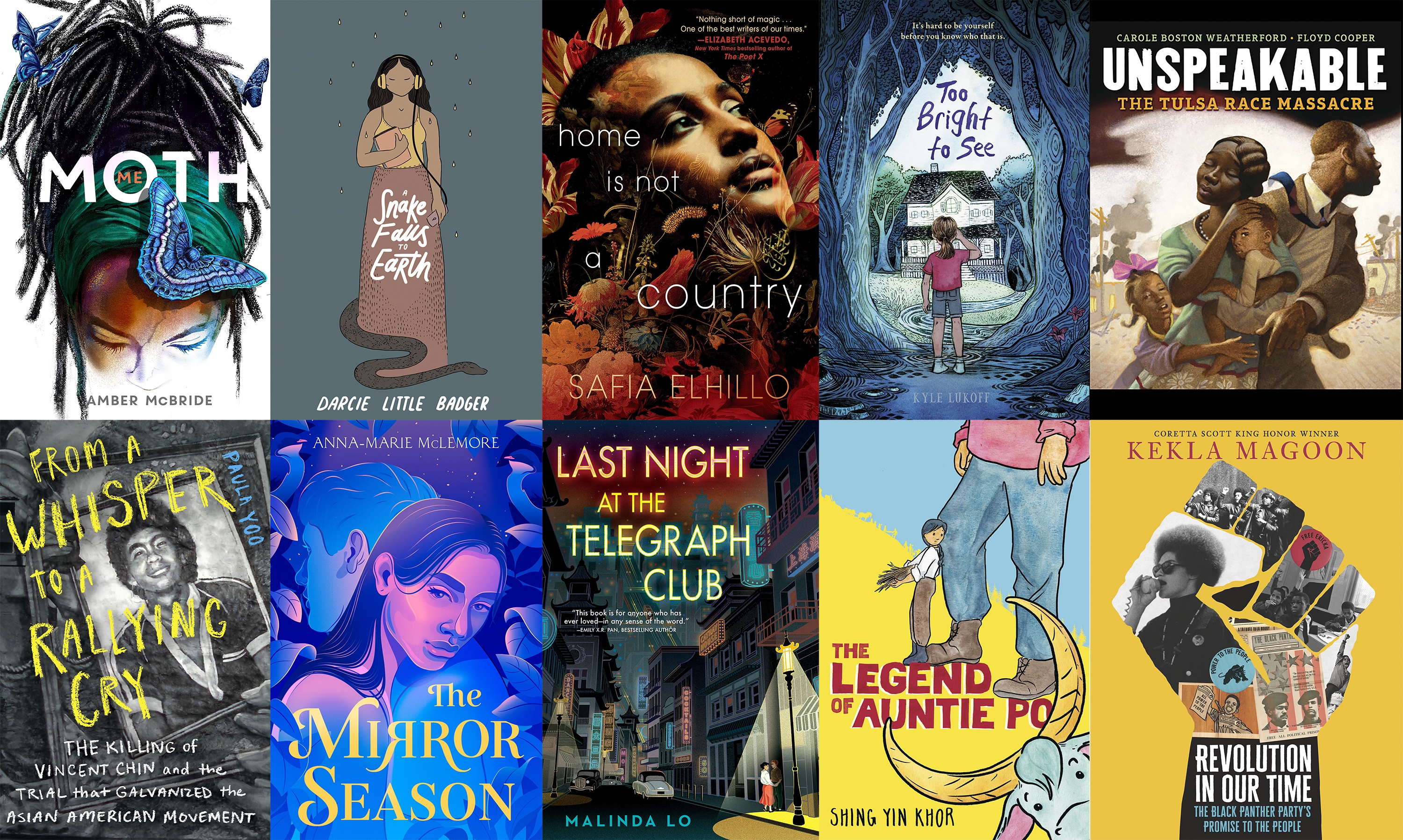
NEW YORK (AP) — Stories ranging from retellings of the myths of Paul Bunyan and of Hans Christian Andersen’s “The Snow Queen” to a look back at the Black Panther Party are among the 10 nominees on the longlist for the National Book Award for young people’s literature.
On Wednesday, the National Book Foundation also announced the longlist for translated books, with fiction originating from Syria, Chile and South Korea among other countries. The French-language author Maryse Conde, often mentioned as a possible Nobel Prize candidate, received her first National Book Award nomination, at age 84, for her novel “Waiting for the Waters to Rise.” Richard Philcox was the translator.
This week, the foundation will reveal its longlists for all five competitive categories: fiction, nonfiction, poetry, young people’s literature and translation.
Judges will narrow the lists to five finalists on Oct. 5 and winners will be announced at a Nov. 17 ceremony in Manhattan. The nonprofit foundation, which presents the awards, plans to hold the event in person this year after making last year’s ceremony virtual because of the pandemic.
In young people’s literature, the list includes Anna-Marie McLemore’s “The Mirror Season,” her contemporary version of “The Snow Queen”; and the graphic novel “The Legend of Auntie Po,” in which Shing Yin Khor draws upon Bunyan and other folktales for a narrative that reflects on race, class and immigration. Darcie Little Badger’s “A Snake Falls to Earth” is based in part on Lipan Apache storytelling traditions.
The other young people’s nominees were Carole Boston Weatherford’s “Unspeakable: The Tulsa Race Massacre,” with illustrations by Floyd Cooper, who died earlier this year; Safia Elhillo’s “Home Is Not a Country”; Malinda Lo’s “Last Night at the Telegraph Club”; Kyle Lukoff’s “Too Bright to See”; Kekla Magoon’s “Revolution in Our Time: The Black Panther Party’s Promise to the People”; Amber McBride’s “Me (Moth)”; and Paula Yoo’s “From a Whisper to a Rallying Cry.”
Translation nominees besides Conde include Elisa Shua Dusapin’s “Winter in Sokcho,” translated from the French by Aneesa Abbas Higgins; Ge Fei’s “Peach Blossom Paradise,” translated from the Mandarin by Canaan Morse; Nona Fernández’s “The Twilight Zone,” translated from the Spanish by Natasha Wimmer; and Bo-Young Kim’s “On the Origin of Species and Other Stories,” translated from the Korean by Joungmin Lee Comfort and Sora Kim-Russell.
Others on the translation longlist were Benjamín Labatut’s “When We Cease to Understand the World,” translated from the Spanish by Adrian Nathan West; Elvira Navarro’s “Rabbit Island,” translated from the Spanish by Christina MacSweeney; Judith Schalansky’s “An Inventory of Losses,” translated from the German by Jackie Smith; Maria Stepanova’s “In Memory of Memory,” translated from the Russian by Sasha Dugdale; and Samar Yazbek’s “Planet of Clay,” translated from the Arabic by Leri Price.
Some societies are more hierarchical than others. How does this affect mentoring conversations? Julie Gould finds out.
Science has become more international in the past few decades. This means that you might encounter a variety of people from different geographical and cultural backgrounds in your lab. So how does this affect your mentoring relationships?
In the second episode of this seven-part Working Scientist podcast series, researchers share some of their cross-cultural mentoring encounters.
These range from Asian attitudes to hierarchies, to a Scandinavian enthusiasm for peer-to-peer mentoring and a very British fixation with mentoring and afternoon tea.
This story was originally published and last updated .
The internet contains many a rabbit hole you can fall into and there is no shortage of them on YouTube. So, if you find yourself sitting through clip after clip from a Japanese restaurant vlogger and are wondering what the comments are saying — you can only presume they're generally nicer than on certain other videos — you can now translate them without having to leave the page!
YouTube viewers on mobile now have access to instant translation for any comment not in the user's native language by tapping a button at the bottom of the message. Users can flip back to the comment's original language by tapping the button again.
Delicious, delicious herring.
Users will be able to translate between more than 100 languages.
Yes, it's a rather simple convenience feature that's been easily plopped down on other social platforms for the sake of many unsavory comments, but maybe we're not looking at the right comments on the right videos?
Comment translation button design in experimental phase.
We first reported on the feature while it was in the experimental phase and exclusively available to YouTube Premium subscribers back in August. The feature started appearing in its revised format a few days ago prior to today's official announcement from the Team YouTube Twitter account.
Now on mobile: A 'Translate' button for YouTube comments in over 100 languages 💬🌎
Unlock conversations with communities around the world in just one click!
Try it out in español, português, Deutsch, Français, Pусский, 日本語, Bahasa & 100+ more
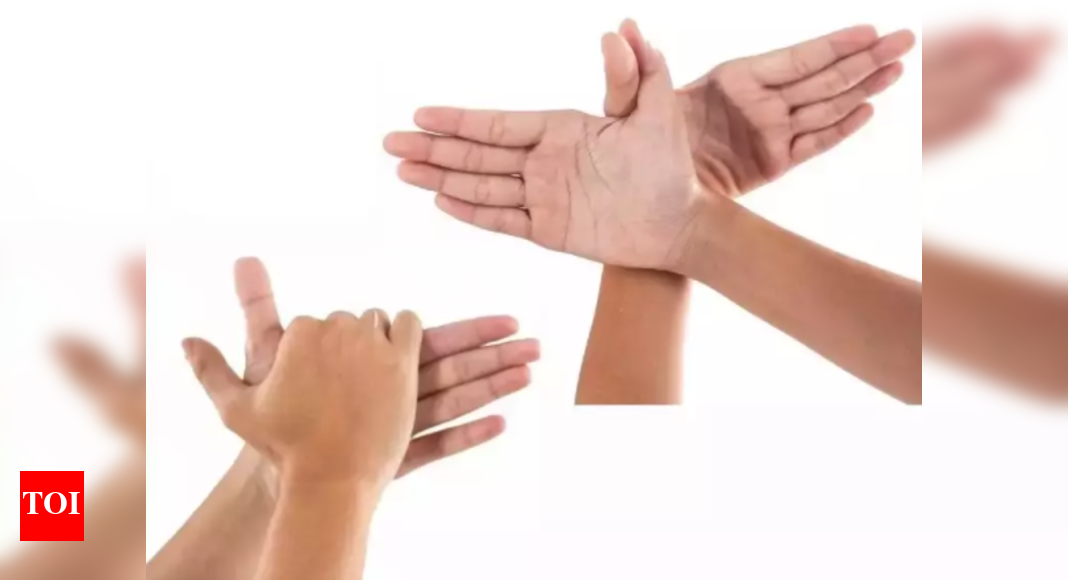
Indian Sign language (ISL) is set to receive a boost as an Indian sign language dictionary of 10,000 words was recently released by PM Modi. “The Dictionary along with NCERT textbooks in ISL accessible teaching-learning resources will benefit special needs students, their teachers, parents and even the general population who would like to learn a new language like ISL. These resources will also promote the use of Indian Sign Language across the country, and thereby give an impetus to inclusive education,” says Sharita Sharma, assistant professor, Sign Language Linguistics, Department of Linguistics at Central University of Rajasthan (CURAJ) who is currently a member of Government’s NEP (2020) Task Force Committee for Standardization of Indian Sign Language, Ministry of Education (MoE).
What is ISL
Indian Sign Language is not only a means of communication for the hearing-impaired, but a is a symbol of their pride and identity. The Rights of Persons with Disabilities (RPwD) Act 2016 which came into force from April 19, 2017, recognises sign language as a means of communication which is especially useful for communication with persons with hearing disability. The Act further mandates governments to promote use of sign language to enable persons with hearing disability to participate and contribute to their community and society.
Congratulations!
You have successfully cast your vote
“But it would be inappropriate to assume that a sign language is only for the hearing impaired as it can be used by everyone for making our societies more inclusive and accessible. The ISL has incrementally evolved from 4000 words to 10000 words and evolved the purpose of wider implementation,” says Gaurav Raheja, professor & head, Department of Architecture & Planning and professor in-charge, Inclusion and Accessibility Services, IIT Roorkee where he is also engaged in the management of a school called Anushruti Academy for the Deaf.
Raheja adds that the ISL has been developed through contextual research and purpose suiting the Indian landscape. The other well-known formats of sign language include American Sign Language, which uses a single hand system and the British Sign language, which uses a two hand system much like the Indian sign language. “The priority of words or vocabulary chosen for India by the Indian Sign Language Research and Training Centre (ISLRTC) are well defined and ranges between words for everyday use with representation from diverse regional contexts of India (like Bihar, Uttarakhand, etc) to a range of legal terms,” Raheja explains. Reaching out
Preparing the ISL Dictionary was no mean task and one that involved “following the good practices of lexicography (process of dictionary making) and Universal Design for Learning (UDL) -- where a set of principles provide teachers with a structure to develop instructions to meet the diverse needs of all learners. “It is at par with most western sign language dictionaries and has been created by both hearing impaired and hearing staff,” Sharma says.
Elaborating further on the efficacy of such a dictionary, V Srinivasa Chakravarthy, professor at IIT Madras, says, “Apart from enriching the vocabulary of special needs children and empowering them to communicate their thoughts efficiently to the rest of the world, such a dictionary gives a common ‘meaning to a visual gesture’ for communication amongst people. This is especially important when students move from different schools to colleges for higher education,” says Chakravarthy, who in collaboration with Sunil Kopparapu from TCS, has come up with Mudrabharati, a fingerspelling system for ISL that is based on the phonetic similarity among the major Indic scripts. A project associate in the team, Amal Jude Ashwin, has developed an AI-based system that can convert the video of a signer signing Mudrabharati into running text.
Digital medium
"A digital dictionary that plays the video of the sign and explains its meaning will be better than the conventional paper based one. Another desirable development is creation of an AI based tool that can convert 10,000 signs in the new ISL dictionary into words and offer that tool as a mobile app. After all, it is not easy for a person to look up a hardcopy of 10,000 symbols,” Chakravarthy says. Wider access
In terms of the Dictionary’s wider dissemination, Sharma explains it is freely available in Open Source platforms such as Youtube and DIKSHA. While most schools for specially abled students have access to these resources, in the pandemic, the education of special needs children did suffer due to the digital and socio-economic divide with physical classes on a pause. Sharma calls for a dictionary app to be made available to all the schools for special needs students, while the government too can distribute dictionary pre-loaded digital tablets or smart phones, so that those without access or means are not left behind. Are faculty equipped
Since the last few years, several schools have made efforts to include qualified teachers with hearing impairment to teach special needs children. The schools have also recruited ISL interpreters to assist in the teaching-learning process. “Rehabilitation Council of India (RCI) has introduced teacher training courses such as Diploma in Teaching Indian Sign Language (DTISL) which is exclusively for hearing impaired students. The BEd Special Education course of RCI has also made changes in its curriculum to include modules of ISL. The existing teachers have been provided training in Indian Sign Language by the government and other organisations, Sharma says.
Melissa Baralt snapped pics of her sons Liam and Milan Rosario this past week on her front porch in Paterson.
Their red uniforms, ironed khakis and new face masks had been laid out the night before in preparation for the first day of school at the Paterson Charter School for Science and Technology.
Baralt’s own prep for the school year involved something aside from buying notebooks, sharpening pencils, or confirming home room numbers. She surveyed her email and text messages for fellow Spanish-speaking families in the district who may still have questions with return of full in-person classes amid the pandemic.
Many did.
“I’m like one of the mom leaders of the group and as a bilingual mother I (can speak) both languages so I’m able to maneuver all the information better,” Baralt told NJ Advance Media. “It’s a language barrier, but it’s also an accessibility barrier.”
Baralt, who has built connections locally as an aide for a city councilman and on the Latinas United For Political Empowerment PAC board, said she’s found communicating with parents informally over the phone the most effective. And communication will be key this school year for families as the coronavirus pandemic — including its impact on schools and younger unvaccinated populations — lingers throughout New Jersey.
Baralt has helped some Spanish-speaking parents navigate masking rules and clarify that remote learning won’t be available except for special exceptions. She noted that there’s room for improvement for translation services in a state where Spanish is the second-most spoken language behind English.
Recent census numbers also show Spanish-speaking populations in New Jersey are growing, with Hispanics now accounting for more than one in five residents.
About 17% of New Jersey’s more than 1.3 million public school children speak Spanish at home, according to the latest available statistics from the state Department of Education.
“Schools are communities and good communication is at the heart of any successful community,” said Steve Baker, a spokesman for the New Jersey Education Association. “Without translation services, some families are effectively excluded from the community, which harms students, makes educators’ jobs more difficult and makes our schools less effective. Providing translation services is a smart investment.”
The level of translation services a Hispanic parent will have access to in New Jersey depends on geography, advocates say. Most school districts promise to translate information if parents or guardians reach out with a specific inquiry. Many also post updates in English and Spanish, as well as other languages, online. But districts vary in how often they make those updates or notify parents about available Spanish-language resources.
For example, Camden appears to be a rare example in New Jersey’s nearly 600 school districts to provide live Spanish simulcasts of board of education meetings online. This includes the option to watch the meetings later if Hispanic families missed the live session. Prior to March, the school district operated like many others in New Jersey when it came to district meetings. It gave the option to hear a Spanish translation over the phone as meetings were happening live but only provided written highlights afterward.
Janet Pablo, who lives in Camden, said that even her district can improve its services.
“Many of us want this information as parents but don’t always know it’s available or how to find it,” Pablo said in Spanish — noting that she prefers videos or speaking with a district official over receiving written updates.
Pablo expects this school year to be more challenging following the death of her husband from a stroke in 2020.
“I’m both the mom and the dad, so it can be difficult to balance everything. I want to see the district be more proactive in how they communicate in Spanish about not only the basics but social emotional wellness and vaccine resources too,” Pablo said.
Pablo’s need to juggle tasks was clear on the first day of school Tuesday. Her oldest, who is 14, gets to school by herself with no problems, but Pablo had to get up early to drive her 9-year-old and 12-year-old to Thomas Dudley Family School.
Heading out in the morning was not an issue, but Pablo had to rush over from work at 2 p.m. when it slipped her mind her two youngest were finishing up an hour earlier than she expected.
“My children are my priority but it can be overwhelming which makes the information the district provides me very important,” she said. “We as parents are very busy and I try to help other Hispanic families if they may be confused about something but don’t always have the time myself.”
The ability for Camden parents, including Pablo, to watch for updates during school board meetings in Spanish, as well as view later, was made possible by the New Jersey-based news and media company, The Latino Spirit.
Janet Pablo and her children Daneicy, 12, and Naem, 9, stand on their from steps after arriving home from the first day of school in Camden, NJ on Tuesday, September 7, 2021.Dave Hernandez | For NJ Advance Media for NJ.com
Diego Maya, who heads The Latino Spirit, says a three-month pilot to provide live translations began in the spring. It was the first time his company has partnered with a municipality for live Spanish simulcast services.
The contract in Camden has been extended for the foreseeable future and the company is now working with two districts in Passaic and Mercer counties to provide the same resources. Maya declined to disclose the specific cities because negotiations are ongoing.
“We’re offering these services and people are responding. We need to keep it going. It takes much more than just posting videos. We need grassroots organizations to reach out to these communities and engage,” Maya said.
Falio-Leyba Martinez, a school board member in Camden who spearheaded the addition of Spanish live translations, acknowledged that there’s more work to be done to bridge the gap for Hispanic residents.
“It’s about making sure the barrier is minimized as much as we can in order to take care of our kids,” said Leyba-Martinez, who translated school information for his parents starting when he was 10.
Mary Sanchez, whose 8-year-old son Jacob goes to school in Paterson, is happy to have access to translators in her district. This year it will be important to keep updated on any shifts to remote learning and the availability of inoculations once vaccines are approved for kids under 12, she said.
“The COVID pandemic is what I’m concerned with first, but there are also (non-coronavirus) topics. Sometimes I’m helping my son with homework and I might not understand something in English in the assignment. I don’t want to confuse him, so I’m always careful about that,” Sanchez said.
Our journalism needs your support. Please subscribe today toNJ.com.
Steven Rodas may be reached atsrodas@njadvancemedia.com.