Wednesday, October 25, 2023

Lenovo's AI-powered sign language translation solution empowers signers in Brazil - Lenovo StoryHub - Translation

The groundbreaking technology, showcased at Lenovo’s Tech World event, uses computer vision and an original AI engine to interpret Libras, the Brazilian sign language, in real-time.

During Lenovo’s Tech World event, a software developer named Gabriel crossed the stage and warmly greeted chairman and CEO Yuanqing Yang using Libras, the official Brazilian Sign Language. While YY, as he’s known at Lenovo, does not know Libras, he understood Gabriel perfectly—through the power of AI. A camera captured the precise movements of Gabriel’s hands while an original AI engine created a real-time text and voice translation. The language barrier between Gabriel and YY dissolved almost instantly, creating seamless and personal connection.

This quick interaction showcased a groundbreaking accessibility solution pioneered by Lenovo researchers. The new technology is poised to transform the lives of countless individuals, among them the 2.3 million people in Brazil who are deaf or hard of hearing.

“This scalable solution exemplifies the potential to create a new AI-powered paradigm for accessibility and inclusion,” said Hildebrando Lima, Lenovo’s director of research and development in Brazil. “It’s a privilege to do such meaningful work serving our communities in Brazil and deliver Lenovo’s vision of AI for all.”
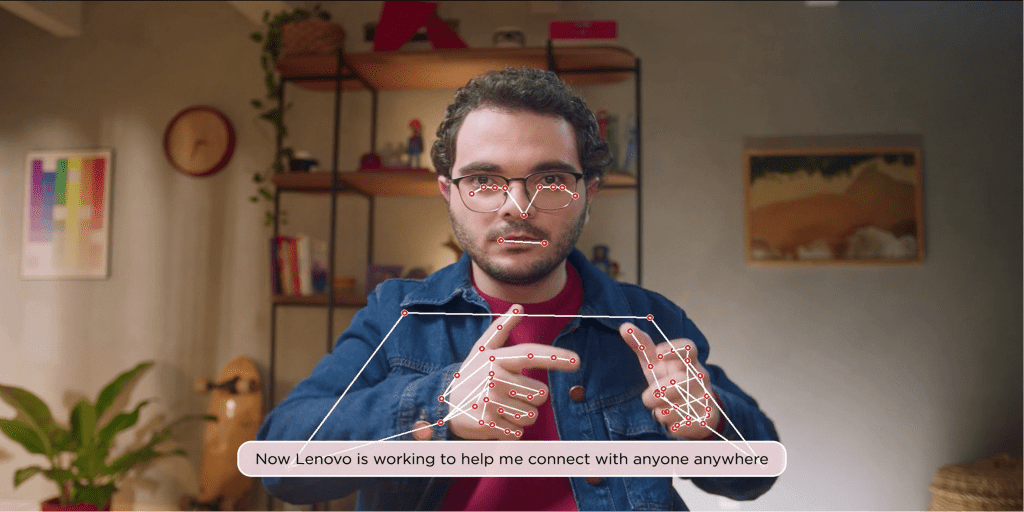
Gabriel signing with Libras

The R&D team built the AI solution to facilitate interactions where a sign language interpreter may be unavailable—from retail spaces to hospitals—to increase autonomy and create connection.

Unseen on the Tech World stage, Lenovo edge servers provided the computing power needed to run the AI and interpret the dense data captured as Gabriel signed a greeting. While cloud computation is an option, the edge servers provide greater speed and reliability at the precise location the AI is needed.

The demonstration was partly a proof of concept—especially Gabriel’s AI voice, which was selected by his own family from 13 custom options—but the underlying technology is quite mature after four years of development. Already, dozens of deaf and hard of hearing individuals using Libras contributed thousands of hours of anonymized video data to build the training set and advance the AI.

Core accessibility R&D

During an internal team discussion at Lenovo in 2019, a software developer fluent in Libras pointed out many day-to-day accessibility issues, and she challenged Lenovo to do more to improve independence and quality of life for the deaf community.

“As a company, we are committed to delivering smarter technology for all, and that means prioritizing inclusivity and considering the diversity of our customers and communities,” Lima said. “We embraced the challenge.”

The Lenovo team in Brazil began thinking about developing a solution: a real-time translation chat tool that lets deaf or hard of hearing people sign to a device’s camera while an algorithm performs the instantaneous translation from Libras into written or spoken Portuguese text. Now, thanks to the ubiquity of generative AI and multilingual data sets, translation can be made into many more languages.

However, achieving real-time video capture and translation between languages presents a staggering amount of data—not the least of which are the individual gestures for each word and the syntax of each sentence. Just as regional accents within a spoken language like English can be dramatically different, movements and styles can be distinct to individuals within Libras.

“There are so many hurdles involved with the video capture alone – including the person’s skin color, background color, lighting, clothing, the speed of a signer’s gestures, and hand positions relative to the body – to name just a few,” Lima said. “On top of that, not every camera has the same level of depth perception.”

To tackle the data challenge, Lenovo collaborated with Brazilian innovation center CESAR, sharing expertise on capturing and cataloguing video to lay the foundation for the AI. Lenovo and CESAR have since created a dataset of thousands of Libras videos to train the core algorithm to identify and contextualize individual gestures. Then Lenovo led the way to develop the breakthrough AI at the heart of the solution.

The AI recognizes both hand positions and the digital articulation points of the signer’s fingers. After processing these movements and gestures, the AI can accurately identify the flow of a sentence and rapidly convert the sign language into text.

The team also collaborated with Lenovo’s Product Diversity Office (PDO), whose mission is to ensure Lenovo products work for everyone, regardless of their physical attributes or abilities. The PDO’s inclusive design experts helped to identify areas of potential concern—skin tone, hair style, corrective lenses, and limb differences, for example—and to make sure product testing accounted for these characteristics.

Delivering real, reliable solutions for all

At a recent internal event in Brazil exploring inclusion in Lenovo workspaces, a member of the Lenovo R&D team heard the story of a deaf person who was unable to fully communicate with her parents throughout childhood. She faced major challenges, relying heavily on sign-language interpreters who could not be available all the time—especially at home.

“Imagine being unable to talk easily to your friends or parents for your entire childhood, or with your colleagues at work,” Lima said. “It’s the kind of intimate, family, education, and workplace inclusion scenario where this solution can change so much.”

The Lenovo R&D team emphasized that the solution is not intended to replace more people learning Libras or other sign languages—instead, it bridges existing communication gaps. Beyond that, the AI might actually be used to accelerate learning sign language, using computer vision to track the accuracy of gestures and “instruct” users to make adjustments. Deployed on wearable tech or through augmented reality, people could have immersive learning experiences with the AI acting as coach.

Lima’s R&D team partnered with Lenovo’s Infrastructure Solutions Group to find an edge computing solution. Relying exclusively on the cloud—and consequently very fast Internet speed—works in some but not all instances. Potential users at a hospital or airport, for example, where time is at a premium, would not want to rely on unpredictable connection. Computing at the edge is also in line with Lenovo’s pocket-to-cloud portfolio that brings AI to the source of the data and into the hands of users.

The next step is to scale the project beyond internal testing. More data points will be needed to roll out a real-time sign language translation interface at scale. The team is exploring self-learning algorithms and other technology to accelerate development, especially as the user base and data sets grow.

Lenovo is also exploring ways to tailor the translation solution to specific industry verticals, such as finance or retail, as the data sets can be more finely tuned and optimized to provide an ideal user experience. As the solution develops and inspires more inclusive technology, the more than 430 million deaf and hard of hearing individuals around the globe may feel the profound potential of AI.

Adblock test (Why?)

Tuesday, October 24, 2023

Ventura continues Spanish interpretation, translation programs - VC Star - Translation

Ventura City Hall sits at the top of California Street overlooking downtown.

Ventura will continue providing Spanish interpretation of live meetings and translation of agendas for the City Council after a pilot program.

The City Council voted unanimously on Monday to keep the processes in place. The council contemplated requiring a 72-hour advance notice to request interpretation services but ultimately decided against it.

“We’ve been trying for years to get our Latino speakers, or our Spanish speakers, to be a part of our community and be active,” said Council member Doug Halter. “I really think we’re on to something. I really think that people are starting to really engage.”

In September 2022, the city approved a six-month pilot program to bring interpretation to council meetings. In March, council members extended the program and added Spanish translation of City Council meeting agendas.

On Monday, staff recommended the city make the program permanent but require advance notice from those seeking translation services.

Council member Jeannette Sanchez-Palacios is concerned that if Spanish speakers don’t provide advance notice, they’ll have to use Webex, a service that hosts online meetings. The translation on Webex is not always reliable, she said.

When a meeting is translated through Webex, Spanish speakers who miss it live are not able to watch the archived version in Spanish, she said.

City Clerk Michael MacDonald said he is exploring the option of dubbing the archived videos of meetings in Spanish they can be watched later.

There has been an increase in people accessing the Spanish language agenda, according to the city. Typically, the translation takes about 72 hours after the agenda is posted.

The time is needed because the city uses a third-party translation service. The city could use artificial intelligence to translate the agenda faster and staff will explore that option, according to the agenda.

On average, the cost to provide interpretation services is around $1,000 per meeting. Translation services range from $200 to $1,000 for each agenda depending on which third-party service is used. With an average of 26 meetings per year, the total cost would be around $26,000 per year for interpretation services and $5,200 to $26,000 each year for translation services.

AI could help reduce costs in the future, MacDonald said, and could even help translate the entire staff report, which is not done currently.

Live translation services without prior requests are only done in Ventura and Oxnard, MacDonald said. Speakers at the meeting were in favor of keeping the services.

Maria Davalos said through an interpreter she wanted to see the services become permanent. 

“The Hispanic community does a lot for Ventura,” Davalos said. “And they do so much for this city, they should be treated in a dignified manner. If our Hispanic people aren’t here … during this season they work a lot, they work extra hours and that’s the reason why they’re not here.” 

Wes Woods II covers West County for the Ventura County Star. Reach him at wesley.woodsii@vcstar.com, 805-437-0262 or @JournoWes.

Adblock test (Why?)

Monday, October 23, 2023

Meta apologizes after auto-translation adds 'terrorist' to profiles - News Channel 5 Nashville - Translation

Meta recently apologized after some Instagram users noticed its auto-translation feature added the word “terrorist” in the English version of a certain combination of words that included no such phrase.

According to independent digital media company 404 Media, the issue affected users with the word “Palestinian” written in English in their bio along with a Palestinian flag emoji and the phrase “alhamdulillah” written in Arabic, which means “thank God” or “praise be to God.” 

When that combination of words was changed to English using Instagram’s “see translation” option, it translated the phrase into the much longer line “Praise be to god, Palestinian terrorists are fighting for their freedom,” 404 Media said.  

One user on TikTok made a video showing how if the word “Palestinian” and the flag emoji were removed from the combination, the translation for “alhamdulillah” would then say “thank God.”

In a statement to several outlets including Guardian Australia, a Meta spokesperson said the issue was fixed earlier this week.

On their website, Meta said it introduced a series of measures to address concerns of misinformation and harmful content spreading on its platforms at the start of the Israel-Hamas war. 

“Our policies are designed to keep people safe on our apps while giving everyone a voice. We apply these policies equally around the world and there is no truth to the suggestion that we are deliberately suppressing voice,” Meta said. 

The social media parent company had already been accused of censoring posts in support of Palestinians on its platforms, The Guardian said. 

Nadim Nashif is the founder and director of 7amleh - The Arab Center for the Advancement of Social Media, which is a social media watchdog group whose stated purpose is to analyze text for racism, hatred and incitement. He told The Guardian they are tracking the issue, and it’s not the first time Meta has been accused of this. 

“Unfortunately, shadow banning is just one of the many ways in which we have seen Palestinian content silenced and censored over the last week,” Nashif said to The Guardian. “This has been a trend of Meta in times of crisis, and we saw a significant spike of Palestinians and allies reporting limited reach and errors with content they posted about the ongoing crisis in Palestine.”

Meta said “it is never our intention to suppress a particular community or point of view,” but that due to “higher volumes of content being reported” surrounding the ongoing conflict, “content that doesn’t violate our policies may be removed in error.” 

The company attributed some issues to glitches or bugs in their systems that reduced the reach of posts “equally around the globe"and "had nothing to do with the subject matter of the content."

SEE MORE: Inside a social media war room fighting for the hostages held by Hamas


Trending stories at Scrippsnews.com

Adblock test (Why?)

하품 (Yawn) (English Translation) – SEVENTEEN - Genius - Translation

[Verse: JOSHUA, Jeonghan]
Over the passing moon
The air is moving away
When did it become so cold?
I guess I really have to forget it now
Even if I practice, I know I can't
You were everything

[Pre-Chorus: DK]
Rolling footsteps
On the piece of paper of my heart, full of scribbles of me
I have a favor written down

[Chorus: SEUNGKWAN, WOOZI]
I don't hate you
You know it was a good choice
You couldn't even tell me, it must've hurt so much
You must have been suffering alone
There's no way I wouldn't know
Because you are my breath
Do not feel sorry
It's just like a yawn when it is not enough

[Instrumental Interlude]

[Pre-Chorus: SEUNGKWAN, WOOZI]
Rolling footsteps
On the piece of paper of my heart, full of scribbles of me (Ah-ah)
There is a wind that I have drawn

[Chorus: Jeonghan, WOOZI, DK]
I don't hate you
You know it was a good choice (Oh-oh)
You couldn't even tell me, it must've hurt so much
You must have been suffering alone
There's no way I wouldn't know
Because you are my breath
Do not feel sorry
It's just like a yawn when it is not enough

[Instrumental Interlude]

[Bridge: WOOZI]
Ya-ya-ya-ya-ya-yawn
Ya-ya-ya-yawn

[Chorus: JOSHUA]
What made me breathe
It was all filled with you
My heart is lacking without you
It's like a hole with pain in it

Adblock test (Why?)

Genius English Translations – SEVENTEEN - 음악의신 (God of Music) (English Translation) - Genius - Translation

[Intro: Joshua]
If there is a God of Music
I want to give you a hug of gratitude
Hey, ho
Ooh, no
Hey, ho

[Verse 1: DK, Hoshi, Vernon, S.Coups]
A universal language
Different alphabets, but no matter as long as there’s music
We can’t communicate with words, but with music
We can be best friends from now on

We've just met but we can dance together
We can mix it up right, sugar and spice
Brass sound and guitar
Anything with four syllables, they say it’s my name
Kung chi pak chi, is that my name, too?
Is this sound also for me?

Kick snare, drum bass, piano, bass line

[Pre-Chorus: Wonwoo, Mingyu, Seungkwan]
What is our happiness
Don’t fret, let’s just dance and sing
This is our happiness
One morе time, hey
Music is our breath
No dangеr here, keep taking it in

Everybody, let’s listen up

[Chorus: Jeonghan, Dino, THE8]
If there is a God of Music
This is a message for you
Gather one note after the other, mm
Dance and sing, this feels amazing

[Post-Chorus: Vernon, Jun]
Kung chi pak chi kung kung chi pak chi yeah
Happiness is now

[Verse 2: Dino, Woozi]
Think about it, even noise is music to us
We each live by our own boom and pow
Even the ants’ footsteps march in harmony, ooh

[Pre-Chorus: Jun, Seungkwan, DK]
What is our happiness
Don’t fret, let’s just dance and sing
This is our happiness (One more time, hey)
Music is our breath
No danger here, keep taking it in

Everybody, let’s listen up

[Chorus: Woozi, Seungkwan, Jeonghan]
If there is a God of Music
This is a message for you
Gather every single note, mm
Dance and sing, this feels amazing

[Post-Chorus: THE8, Hoshi]
Kung chi pak chi kung kung chi pak chi yeah
If there is a God of Music

[Bridge]
SEVENTEEN to the world
The whole world sing in unison

[Outro: S.Coups, Wonwoo]
Kung chi pak chi kung kung chi pak chi yeah
If there is a God of Music

Adblock test (Why?)

Translating the Wise Words of Pope John Paul II - National Catholic Register - Translation

In 2003, toward the end of John Paul’s pontificate, I received one of the greatest honors in my life.

I never met St. John Paul II personally, although during his visits to my native Poland and at European Youth Day in Italy in 1995 I saw him several times at a close distance. But it never crossed my mind that I would yet “meet” him in a way that I could never have imagined.

John Paul II has always been a part of my life, just like many other Poles born in the 1970s. When we became conscious of the reality around us, he was already pope, and he continued in his papal service until we moved well into adulthood. So on the one hand, we sort of took him for granted; and on the other, we all felt his constant presence in our daily lives. To us, he was not only a messenger of God in his capacity of the successor of St. Peter, and so a spiritual mentor, the highest moral authority, but also a great father figure, beloved by the young and the old alike, and a national hero, respected even by those with little regard for the Catholic Church. When we still struggled behind the Iron Curtain drawn over Poland by Soviet Russia, he was our best advocate in the free world, an advocate also for our liberty — a very successful one, as history proved later.

In 2003, toward the end of the Holy Father’s pontificate, I received one of the greatest honors in my life. I had done some language work for the Polish section of the Secretariat of State at the Vatican, and I was asked to translate the Holy Father’s apostolic exhortation Pastores Gregis (The Shepherds of the Flock). Originally written in Italian, it needed to be rendered into Polish. Later, I was also given the job of translating his “Letter to Priests” for Holy Thursday 2004. The work was not easy, especially in the case of the exhortation, which is a very formal document, but it was most certainly worth every effort.

The “Letter to Priests” was my last translation for the Vatican. In October 2004, I was diagnosed with cancer, and my life changed practically overnight. At the time, I was employed as a translator by the Polish branch of an Italian automotive company and, thankfully, I was allowed to work from home (in those days, home office was rarely considered an option). My treatment, extending over several months and including chemotherapy and radiotherapy, had its ups and downs. I was still in touch with the director of the Polish section at the Vatican, a close cooperator of John Paul II, and at one point he told me that he was going to place a card with my name on the Holy Father’s kneeler, along with other similar intentions. Needless to say, I was speechless. Soon afterward, John Paul II returned to the Father’s House, and, a few months later, I was declared cancer-free.

As I was slowly returning to a more stable daily routine, I wanted to find a way to express my gratitude to the Holy Father. Around that time, “Papal Day” was celebrated in Poland in commemoration of his election to the See of Peter. It is organized annually by the Work of the New Millennium Foundation, created in 2000 as a “living monument” to the Pope, in response to his concern about many families driven into poverty. The foundation aims to help talented young people from low-income families with their education, as well as to promote the Polish pope’s teaching and Christian culture in general.

I wanted to contribute to this great “mosaic” of nationwide help inspired by gratitude toward St. John Paul II, but my financial situation did not allow me to go beyond a modest offering. When I asked a vicar at my parish for advice, he surprised me with an idea that had not occurred to me. Knowing that I had provided private tutoring in English for many years, he suggested that I find some time to offer free lessons to a young person who cannot afford them. I followed his advice; and with his help, I contacted a family in our parish. For more than a year, I was helping two siblings who had English at school but needed extra help. And I experienced the simple truth that a gift often enriches the giver even more than the receiver. To this day, I remember the joy I felt every time my young students showed improvement and brought home better grades.

Nearly 20 years after those events, I am being granted another extraordinary honor. Just like before, it has come along through a chain of amazing and unpredictable “coincidences” or, rather, “God-incidences,” that I am contributing to the National Catholic Register. It is so beautiful to witness how God leads us through the tangled paths of our lives, often through years of failed hopes and broken dreams, and then, in a sudden flash of his grace, we receive something that surpasses those hopes and dreams, and we realize how perfectly all the puzzles of our daily joys and sorrows fit together.

As John Paul II encouraged: “I plead with you – never, ever give up on hope, never doubt, never tire, and never become discouraged.”

I am convinced that St. John Paul II has once again carried me in his prayer.

Kelly Dudek is a passionate philologist, fascinated by the nature of language as well as the language of nature, which makes The Lord of the Rings her all-time favorite book. She received her M.A. in English philology at the Jagiellonian University and complemented it with a course in journalism at the Pontifical University of John Paul II, both in Kraków, Poland. A translator and editor for Carmelite Publishing, she has volunteered at multilingual events like World Youth Day and the European Youth Meeting. Her publications include poetry and prose in the Catholic weekly Niedziela and a weekly column in her parish newsletter. Most recently, she managed international communications for the Family Pastoral Care Foundation, helping Ukrainian refugees.

Adblock test (Why?)

Translating the Wise Words of Pope John Paul II - National Catholic Register - Translation

In 2003, toward the end of John Paul’s pontificate, I received one of the greatest honors in my life.

I never met St. John Paul II personally, although during his visits to my native Poland and at European Youth Day in Italy in 1995 I saw him several times at a close distance. But it never crossed my mind that I would yet “meet” him in a way that I could never have imagined.

John Paul II has always been a part of my life, just like many other Poles born in the 1970s. When we became conscious of the reality around us, he was already pope, and he continued in his papal service until we moved well into adulthood. So on the one hand, we sort of took him for granted; and on the other, we all felt his constant presence in our daily lives. To us, he was not only a messenger of God in his capacity of the successor of St. Peter, and so a spiritual mentor, the highest moral authority, but also a great father figure, beloved by the young and the old alike, and a national hero, respected even by those with little regard for the Catholic Church. When we still struggled behind the Iron Curtain drawn over Poland by Soviet Russia, he was our best advocate in the free world, an advocate also for our liberty — a very successful one, as history proved later.

In 2003, toward the end of the Holy Father’s pontificate, I received one of the greatest honors in my life. I had done some language work for the Polish section of the Secretariat of State at the Vatican, and I was asked to translate the Holy Father’s apostolic exhortation Pastores Gregis (The Shepherds of the Flock). Originally written in Italian, it needed to be rendered into Polish. Later, I was also given the job of translating his “Letter to Priests” for Holy Thursday 2004. The work was not easy, especially in the case of the exhortation, which is a very formal document, but it was most certainly worth every effort.

The “Letter to Priests” was my last translation for the Vatican. In October 2004, I was diagnosed with cancer, and my life changed practically overnight. At the time, I was employed as a translator by the Polish branch of an Italian automotive company and, thankfully, I was allowed to work from home (in those days, home office was rarely considered an option). My treatment, extending over several months and including chemotherapy and radiotherapy, had its ups and downs. I was still in touch with the director of the Polish section at the Vatican, a close cooperator of John Paul II, and at one point he told me that he was going to place a card with my name on the Holy Father’s kneeler, along with other similar intentions. Needless to say, I was speechless. Soon afterward, John Paul II returned to the Father’s House, and, a few months later, I was declared cancer-free.

As I was slowly returning to a more stable daily routine, I wanted to find a way to express my gratitude to the Holy Father. Around that time, “Papal Day” was celebrated in Poland in commemoration of his election to the See of Peter. It is organized annually by the Work of the New Millennium Foundation, created in 2000 as a “living monument” to the Pope, in response to his concern about many families driven into poverty. The foundation aims to help talented young people from low-income families with their education, as well as to promote the Polish pope’s teaching and Christian culture in general.

I wanted to contribute to this great “mosaic” of nationwide help inspired by gratitude toward St. John Paul II, but my financial situation did not allow me to go beyond a modest offering. When I asked a vicar at my parish for advice, he surprised me with an idea that had not occurred to me. Knowing that I had provided private tutoring in English for many years, he suggested that I find some time to offer free lessons to a young person who cannot afford them. I followed his advice; and with his help, I contacted a family in our parish. For more than a year, I was helping two siblings who had English at school but needed extra help. And I experienced the simple truth that a gift often enriches the giver even more than the receiver. To this day, I remember the joy I felt every time my young students showed improvement and brought home better grades.

Nearly 20 years after those events, I am being granted another extraordinary honor. Just like before, it has come along through a chain of amazing and unpredictable “coincidences” or, rather, “God-incidences,” that I am contributing to the National Catholic Register. It is so beautiful to witness how God leads us through the tangled paths of our lives, often through years of failed hopes and broken dreams, and then, in a sudden flash of his grace, we receive something that surpasses those hopes and dreams, and we realize how perfectly all the puzzles of our daily joys and sorrows fit together.

As John Paul II encouraged: “I plead with you – never, ever give up on hope, never doubt, never tire, and never become discouraged.”

I am convinced that St. John Paul II has once again carried me in his prayer.

Kelly Dudek is a passionate philologist, fascinated by the nature of language as well as the language of nature, which makes The Lord of the Rings her all-time favorite book. She received her M.A. in English philology at the Jagiellonian University and complemented it with a course in journalism at the Pontifical University of John Paul II, both in Kraków, Poland. A translator and editor for Carmelite Publishing, she has volunteered at multilingual events like World Youth Day and the European Youth Meeting. Her publications include poetry and prose in the Catholic weekly Niedziela and a weekly column in her parish newsletter. Most recently, she managed international communications for the Family Pastoral Care Foundation, helping Ukrainian refugees.

Adblock test (Why?)