“Anxious”means “worried or uneasy,” but it has often been used somewhat interchangeably with the word “eager,”to mean “full of keen desire” — but that flexibility seems to be changing.
We got the word “anxious” directly from Latin where it meant essentially the same thing:worried, disturbed, uneasy, and so on.
Eager
“Eager,” on the other hand, comes directly from French, and an interesting usage quirk is that although French did have the “full of keen desire” meaning, it had manymorenegative meanings for the word. The Oxford English Dictionary mentions “severe,” “fierce,” “savage,” “pungent,” “strenuous,” and more. Another meaning was “sour,” and that’s one of the roots of the Latin word for “vinegar,” which was essentially “wine eager” or “wine sour.”
English also had many negative meanings for “eager” in the beginning, but they’ve mostly become obsolete, rare, or regional. Today in English, when you hear the word “eager,” you think of positive emotions.
‘Anxious’ or ‘eager’?
In the recent past, let’s say the early 1900s, usage writers started making a big deal about not using “anxious” to mean “eager.” You were eager to take your apples to the market to sell if it was just for some extra money, but you would have been anxious about taking your apples to market if you absolutely had to get a certain amount of money for them to be able to survive the winter. You’re eager for good things, but you’re anxious for bad things or things that make you worried.
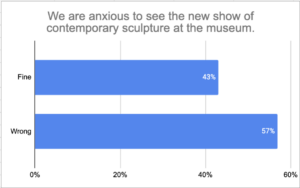
“Anxious” had been evolving, though. By 10 or 15 years ago, many people were using the words interchangeably. Three major dictionaries imply that it’s OK to use “anxious” to mean “eager,” fromdictionary.comsaying it’s fully standardto theAmerican Heritage Dictionarysaying in 2014 that resistance was waning. Fifty-seven percent of their usage panel said it was fine to use “anxious” to mean “eager,” and the most recent edition ofGarner’s Modern English Usagesays using “anxious” to mean “eager” is ubiquitous.
However, I have seen indications that resistance to using “anxious” to mean “eager” is actually growing again, which is very uncommon! When a word starts becoming accepted, it usually continues to become more accepted. But in this case, cultural factors are becoming stronger than linguistic factors. I recently did a poll on Facebook, and only 43% of the people who responded said it was OK to use “anxious” to describe an event someone was looking forward to — 14% fewer than the American Heritage Dictionary Usage Panel in 2014. That was surprising to me.
Mental health an ‘anxious’
But after reading the comments — sometimes yes, it does pay to read the comments! — it became more clear: We’ve become much more open about mental illness in the last 10 or so years, and the word “anxious” is used more frequently in a medical context. Which means that although anxiety isn’t stigmatized like it used to be, people do view it as something they’d rather not have. If you’re going to the doctor and getting a prescription for being anxious, you’re not going to associate that word with happy feelings or being full of keen desire.
The bottom line
So although usage guides no longer say it’s wrong to use “anxious” to mean “eager,” it’s probably still a good idea to keep the words separate. You’re eager to see the dessert tray at a fancy restaurant, but anxious about seeing the final bill. You’re eager to get your new puppy, but anxious about how it might get along with your cat.
Argentine slang takes inspiration from almost anywhere, often using mundane nouns and spicing them up to give them new meaning, so how could fruits and vegetables escape that fate? We’ve had perejil as a previous “translation trouble” — a garnish that becomes much stronger with a dose of lunfardo — so I thought I’d take readers to our linguistic verdulería for a different sort of five-a-day.
Mandar fruta/cualquier verdura
“Send fruit” and “any vegetable” mean the same thing so we can group them together: it basically means doing something on the fly without taking it seriously. The phrases apparently come from long-distance comforts in the 19th century, with people asking their family to “send them fruit” from home when they moved to other parts of the country. The stories differ in how mandar fruta went from earnest plea to admonishment but it seems to stem from the disappointment of receiving packages without fruit: saying in contrast that “any old vegetable” or cualquier verdura was sent instead.
Now, mandar fruta means to say things without understanding and cualquier verdura can also become hacer cualquiera or cualquier cosa — doing something poorly, usually in a rush and completely missing the mark.
Banana
This came up in conversation with the innocent and potentially philosophical question: “What does it mean to be a banana?”
A banana is basically a showy person who thinks they’re all that — and in trying to be cool they look ridiculous in their inflated sense of self. It can be a noun modified for the person’s gender, e.g. sos un banana, or a descriptor: es re banana (they’re so banana).
Here’s a bonus: the warning phrase “A papá mono/mamá mona con bananas verdes.” This basically means “Don’t try to fool me” — you wouldn’t trick a parent monkey, a seasoned and mature fruit expert, with unripe bananas. Growing up abroad in a bilingual household with a wisecracker for a father, I genuinely learned this one as “To father monkey with green bananas” — only to realize on returning to Argentina that I didn’t know its original Spanish form. Translation troubles, indeed.
Nabo
With the same sentence structure as sos un banana, the unassuming turnip can also become a bit of a put-down. But better to be a turnip than a banana in Argentina (what a sentence) because nabo usually just means that someone’s a bit of a chump. If you forgot your keys, you might call yourself a turnip. If someone tells a particularly bad joke, they could be called a turnip without fear of genuinely offending them. In fact, if you wanted your gentle blow to someone’s intelligence to be even softer and kind of dorky, you can use naboleti.
¡Chupate esta mandarina!
When you have an ace up your sleeve, particularly if you’ve accomplished something and want to throw it in someone’s face, you can tell them to “suck on this tangerine.” This is usually negative or to the other person’s detriment — presumably because tangerines can be bitter — but can also be used to express surprise. I’ve heard it a lot in the card game truco, when a winning hand is thrown down with an exultant ¡chupate esta mandarina!
The closest English equivalent, an approximation which I find delightful — “How’d you like them apples?”
¡Apa la papa!
This is basically the opposite of chupate esta mandarina, although I don’t hear it often. Apa la papa is so satisfying and fun, though, that I really think we should say it more. Apa and epa are simple and versatile exclamations but as with anything in life, you add a potato and the result is necessarily positive — congratulatory amazement, even. Someone graduated? ¡Apa la papa! You did the thing? ¡Aapaa la papaa!
Really draw out those A’s for full effect. Go on, have some fun with cries of tubular triumph today.
Share your thoughts and translation hang-ups with us onFacebook,TwitterorInstagram!
The Arden Encyclopedia of Shakespeare’s Language, published this week, aims to be the ‘first fully corpus-based dictionary of Shakespeare’s language and most comprehensive since Alexander Schmidt’s in the early 1870s.’
William Shakespeare used the word dotage to capture reduced mental ability (as in being blindly in love) rather than as a quaint term for old age, successes were really outcomes – one could talk of a ‘bad success’ – and, it turns out, the word bastard back then most often referred to a flower that was genetically hybrid.
Advertisement
While dinner was preferred by Shakespeare for what we might think of as lunch (although his contemporaries used it to refer to an evening meal), beef, as today, was strongly associated with the English, but particularly the lower ranks (it was thought to reduce intelligence). And while fish was not only considered inferior to red meat, it was also considered to be ‘decidedly dodgy’, being associated with Catholicism or sex.
'To Kate' (v.) #cl2023
Quick peek inside the new @Ardenpublisher Encyclopedia of #Shakespeare Language
Every single word of his plays is included (minus proper nouns and numbers)! pic.twitter.com/cO46TeWzu4
— Katharine Kavanagh (@BustingFree) July 6, 2023
This new research by Lancaster University sheds light on the times with the publication of The Arden Encyclopedia of Shakespeare’s Language, published by Bloomsbury earlier this week. Its publication comes after 25 years of preparation, a £1 million Arts and Humanities Research Council grant, a team of up to 25 researchers, and seven years of hard work.
Advertisement
The project, conceived and led by Jonathan Culpeper, a Professor of English Language and Linguistics at Lancaster University, will result in a unique 5 volume reference work, detailing and illuminating Shakespeare’s rich language. A key feature of the project is that is uses corpus linguistics, the computer-aided analysis of massive datasets of language, to provide evidence-based accounts of Shakespeare’s language.
And not just of Shakespeare’s words. The volumes of the Encyclopedia will also reveal the linguistic thumbprints of plays and characters plays, the articulation of themes such as love and death, and the networks of character interaction. Professor Culpeper, who worked together with Dr Andrew Hardie and Dr Jane Demmen, also from Lancaster University, on these volumes, explains “This is the first fully corpus-based dictionary of Shakespeare’s language and most comprehensive since Alexander Schmidt’s in the early 1870s.”
This month sees the publication of the first two volumes, which together constitute a dictionary. Volumes 1 and 2 comprise 20,000 word-entries gleaned from a million-word corpus of Shakespeare’s plays and compared with a matching million-word corpus of contemporary plays, along with huge corpus of 320 million words of various writings of the period.
“So why the comparisons?” asks Professor Culpeper. “Other dictionaries define Shakespeare by looking just at Shakespeare. The result is a bit circular – Shakespeare’s words had lives amongst his contemporaries, and we pay attention to that, along with what they are doing in Shakespeare’s plays.”
Advertisement
It is obvious perhaps that wicked occurs densely in religious texts of the time, but who would have guessed that of the highly frequent word ourselves? Frequent words such as alas or ah are revealed to be heavily used by female characters, doing the emotional work of lamentation in the plays (especially histories).
“Frequent words,” Professor Culpeper comments, “often excluded from previous Shakespearean dictionaries, have a wood for the trees problem.”
The dictionary also surveys the infrequent, flagging words that occur but once in Shakespeare, such as bone-ache (syphilis) or ear-kissing (whispering, though other writers used it for flattering), and words that seem to have their earliest occurrence in Shakespeare (including, the decidedly modern-sounding self-harming).
Advertisement
The Encyclopedia is written for a general audience. The remaining volumes will be published over the next three years. To learn more, please visit the publisher’s website or buy this set on Amazon.com.
Being a small part of the @ShakespeareLang project was one of the highlights of my time at @LAEL_LU. Holding the encyclopedia for the first time earlier this week was really special. Congratulations to @j_culpeper, @HardieResearch and @JJDemmen on these first two volumes!! pic.twitter.com/3aoAtfych7
— Mathew Gillings (@mathewgillings) July 6, 2023
Top Image: Work on a new ‘verbal treasure trove’ captures nuances and uses of Shakespeare’s words. Phot courtesy Lancaster University, UK
During your trial you will have complete digital access to FT.com with everything in both of our Standard Digital and Premium Digital packages.
Standard Digital includes access to a wealth of global news, analysis and expert opinion. Premium Digital includes access to our premier business column, Lex, as well as 15 curated newsletters covering key business themes with original, in-depth reporting. For a full comparison of Standard and Premium Digital, click here.
Change the plan you will roll onto at any time during your trial by visiting the “Settings & Account” section.
What happens at the end of my trial?
If you do nothing, you will be auto-enrolled in our premium digital monthly subscription plan and retain complete access for 65 € per month.
For cost savings, you can change your plan at any time online in the “Settings & Account” section. If you’d like to retain your premium access and save 20%, you can opt to pay annually at the end of the trial.
You may also opt to downgrade to Standard Digital, a robust journalistic offering that fulfils many user’s needs. Compare Standard and Premium Digital here.
Any changes made can be done at any time and will become effective at the end of the trial period, allowing you to retain full access for 4 weeks, even if you downgrade or cancel.
When can I cancel?
You may change or cancel your subscription or trial at any time online. Simply log into Settings & Account and select "Cancel" on the right-hand side.
You can still enjoy your subscription until the end of your current billing period.
What forms of payment can I use?
We support credit card, debit card and PayPal payments.
William Shakespeare used the word dotage to capture reduced mental ability (as in being blindly in love) rather than as a quaint term for old age, successeswere really outcomes – one could talk of a ‘bad success’ – and, it turns out, the word bastard back then most often referred to a flower that was genetically hybrid.
A new dictionary, a verbal treasure trove of the nuances and uses of Shakespeare’s words, is published this week.
While dinner was preferred by Shakespeare for what we might think of as lunch (although his contemporaries used it to refer to an evening meal), beef, as today, was strongly associated with the English, but particularly the lower ranks (it was thought to reduce intelligence).
And while fish was not only considered inferior to red meat, it was also considered to be ‘decidedly dodgy’, being associated with Catholicism or sex.
This new research by Lancaster University sheds light on the times with the publication of The Arden Encyclopedia of Shakespeare’s Language, to be published by Bloomsbury.
Its publication comes after 25 years of preparation, a £1 million Arts and Humanities Research Council grant, a team of up to 25 researchers, and seven years of hard work.
The project, conceived and led by Jonathan Culpeper, a Professor of English Language and Linguistics at Lancaster University, will result in a unique 5 volume reference work, detailing and illuminating Shakespeare’s rich language.
A key feature of the project is that is uses corpus linguistics, the computer-aided analysis of massive datasets of language, to provide evidence-based accounts of Shakespeare’s language.
And not just of Shakespeare’s words.
The volumes of the Encyclopedia will also reveal the linguistic thumbprints of plays and characters plays, the articulation of themes such as love and death, and the networks of character interaction.
This month sees the publication of the first two volumes, which together constitute a dictionary.
Professor Culpeper, who worked together with Dr Andrew Hardie and Dr Jane Demmen, also from Lancaster University, on these volumes, said: “This is the first fully corpus-based dictionary of Shakespeare’s language and most comprehensive since Alexander Schmidt’s in the early 1870s.”
Volumes 1 and 2 comprise 20,000 word-entries gleaned from a million-word corpus of Shakespeare’s plays and compared with a matching million-word corpus of contemporary plays, along with huge corpus of 320 million words of various writings of the period.
Professor Culpeper said: “So why the comparisons?
“Other dictionaries define Shakespeare by looking just at Shakespeare. The result is a bit circular – Shakespeare’s words had lives amongst his contemporaries, and we pay attention to that, along with what they are doing in Shakespeare’s plays.”
It is obvious perhaps that wicked occurs densely in religious texts of the time, but who would have guessed that of the highly frequent word ourselves?
Frequent words such as alas or ah are revealed to be heavily used by female characters, doing the emotional work of lamentation in the plays (especially histories).
“Frequent words,” Professor Culpeper comments, “often excluded from previous Shakespearean dictionaries, have a wood for the trees problem.”
The dictionary also surveys the infrequent, flagging words that occur but once in Shakespeare, such as bone-ache (syphilis) or ear-kissing (whispering, though other writers used it for flattering), and words that seem to have their earliest occurrence in Shakespeare (including, the decidedly modern sounding self-harming).
The Encyclopedia is written for a general audience. The remaining volumes will be published over the next three years.
From Italy: A Sister’s Story, Donatella Di Pietrantonio, translated from the Italian by Ann Goldstein
It’s the darkest time of night. Adriana, a baby in her arms, hammers on her sister’s door. Who is she running from? What uncomfortable truth is she carrying with her? Like a whirlwind, Adriana upends her sister’s life bringing chaos and cataclysmic revelations.
Years later, the narrator gets an unexpected, urgent summons back to Pescara, her hometown. She embarks on a long journey through the night, and through the folds and twists of her memory, from her and her sister’s youth, their loves and losses, secrets and regrets. Back in Borgo Sud, the town’s fishermen’s quarter, in that impenetrable yet welcoming microcosm, she will discover what really happened, and attempt to make peace with the past.
From Indonesia: The Birdwoman’s Palate, Laksmi Pamuntjak, translated from the Indonesian by Tiffany Tsao
Aruna is an epidemiologist dedicated to food and avian politics. One is heaven, the other earth. The two passions blend in unexpected ways when Aruna is asked to research a handful of isolated bird flu cases reported across Indonesia. While it’s put a crimp in her aunt’s West Java farm, and made her own confit de canard highly questionable, the investigation does provide an irresistible opportunity.
It’s the perfect excuse to get away from corrupt and corrosive Jakarta and explore the spices of the far-flung regions of the islands with her three friends: a celebrity chef, a globe-trotting “foodist,” and her coworker Farish.
From Medan to Surabaya, Palembang to Pontianak, Aruna and her friends have their fill of local cuisine. With every delicious dish, she discovers there’s so much more to food, politics, and friendship. Now, this liberating new perspective on her country – and on her life – will push her to pursue the things she’s only dreamed of doing.
From Slovakia: Vanity Unfair, Zuzana Cigánová, translated from the Slovak by Magdalena Mullek
An accidental pregnancy, a good-looking man who cares about no one but himself, marriage because the man “had a bit of a Christian upbringing”, and divorce – that is the trajectory of Pipina’s life, leading to single motherhood and a thousand cruelties of everyday life because she is an ugly woman in a world where ugliness is worse than a death sentence. At every turn, she is reminded of her inferiority. She can’t wait for the end of each day when she can sit in the stairwell outside of her dilapidated apartment and retreat into her thoughts. Her drab life full of indignities dissolves only in her beautiful, cinematic dreams. In them, she experiences whatever she can’t do or have in real life.
From Morocco: Straight from the Horse’s Mouth, Meryem Alaoui, translated from the French by Emma Ramadan
34-year-old prostitute Jmiaa reflects on the bustling world around her with a brutal honesty, but also a quick wit that cuts through the drudgery. Like many of the women in her working-class Casablanca neighbourhood, Jmiaa struggles to earn enough money to support herself and her family – often including the deadbeat husband who walked out on her and their young daughter. While she doesn’t despair about her profession like her roommate, Halima, who reads the Quran between clients, she still has to maintain a delicate balance between her reality and the “respectable” one she paints for her own more conservative mother.
This daily grind is interrupted by the arrival of an aspiring young director, Chadlia, whom Jmiaa takes to calling “Horse Mouth.” Chadlia enlists Jmiaa’s help on a film project, initially just to make sure the plot and dialogue are authentic. But when she’s unable to find an actress who’s right for the starring role, she turns again to Jmiaa, giving the latter an incredible opportunity for a better life.
From Argentina: The Dangers of Smoking in Bed, Mariana Enriquez, translated from the Spanish by Megan McDowell
Welcome to Buenos Aires, a city thrumming with murderous intentions and morbid desires, where missing children come back from the dead and unearthed bones carry terrible curses. These brilliant, unsettling tales of revenge, witchcraft, fetishes, disappearances and urban madness spill over with women and girls whose dark inclinations will lead them over the edge.
From Cameroon: Dark Heart of the Night, Léonora Miano, translated from the French by Tamsin Black
What is Africa’s own “heart of darkness”? It is what confronts Ayané when, after three years abroad, she returns to the Central African village of her birth. Now an “outsider” with foreign ways distrusted by her fellow villagers, she must face alone the customs and superstitions that bind this clan of men and women. When invading militia organise a horrific ceremony that they claim will help reunite Africa, Ayané is forced to confront the monstrosity of the act that follows, as well as the responsibility that all the villagers must bear for silently accepting evil done in their name.
From Palestine: Minor Detail, Adania Shibli, translated from the Arabic by Elisabeth Jaquette
Minor Detail begins during the summer of 1949, one year after the war that the Palestinians mourn as the Nakba – the catastrophe that led to the displacement and expulsion of more than 700,000 people – and the Israelis celebrate as the War of Independence. Israeli soldiers capture and rape a young Palestinian woman, and kill and bury her in the sand. Many years later, a woman in Ramallah becomes fascinated to the point of obsession with this “minor detail” of history.
From South Korea: Concerning My Daughter, Kim Hye-jin, translated from the Korean by Jamie Chang
When a mother allows her 30-something daughter to move into her apartment, she wants for her what many mothers might say they want for their child: a steady income, and, even better, a good husband with a good job with whom to start a family. But when Green turns up with her girlfriend, Lane, in tow, her mother is unprepared and unwilling to welcome Lane into her home. In fact, she can barely bring herself to be civil. Having centred her life on her husband and child, her daughter’s definition of family is not one she can accept. Her daughter’s involvement in a case of unfair dismissal involving gay colleagues from the university where she works is similarly strange to her. And yet when the care home where she works insists that she lower her standard of care for an elderly dementia patient who has no family, who travelled the world as a successful diplomat, who chose not to have children, Green’s mother cannot accept it. Why should not choosing a traditional life mean that your life is worth nothing at all?
From Germany: Identitti, Mithu Sanyal, translated from the German by Alta L Price
Nivedita (aka Identitti), a well-known blogger and doctoral student is in awe of her supervisor – superstar postcolonial and race studies South-Asian professor Saraswati. But her life and sense of self are turned upside down when it emerges that Saraswati is actually white. Nivedita’s praise of her professor during a radio interview just hours before the news breaks – and before she learns the truth – calls into question her own reputation as a young activist.
Following the uproar, Nivedita is forced to reflect on the key moments in her life, when she doubted her identity and her place in the world. As debates on the scandal rage on social media, blogs, and among her closest friends, Nivedita’s assumptions are called into question as she reconsiders the lessons she learned from her adored professor.
From India: Bhairavi, The Runaway, Shivani, translated from the Hindi by Priyanka Sarkar
A still, dense, ancient forest. A dark cave deep within. And in it a woman-child whose beauty can move the most pious to sin. Who is she and why did she jump from a moving train to land in the biggest cremation ground teeming with Aghori Sadhus?
In this story spanning generations and redolent with Gothic imagery, Shivani aka Gaura Pant tells the story of a woman’s life, her moral and mental strength and her resilience. She also examines the choices women have in her beautiful, descriptive prose.
From Japan: Scattered All Over the Earth, Yoko Tawada, translated from the Japanese by Margaret Mitsutani
Welcome to the not-too-distant future: Japan, having vanished from the face of the earth, is now remembered as “the land of sushi.” Hiruko, a former citizen and a climate refugee herself, has a job teaching immigrant children in Denmark with her invented language Panska (Pan-Scandinavian): “homemade language. no country to stay in. three countries I experienced. insufficient space in brain. so made new language. homemade language.”
As she searches for anyone who can still speak her mother tongue, Hiruko soon makes new friends. Her troupe travels to France, encountering an umami cooking competition; a dead whale; an ultra-nationalist named Breivik; unrequited love; Kakuzo robots; red herrings; uranium; an Andalusian matador. Episodic and mesmerising scenes flash vividly along, and soon they’re all next off to Stockholm.
From Ukraine: The Museum of Abandoned Secrets, Oksana Zabuzhko, translated from the Ukranian Nina Shevchuk-Murray
Spanning 60 tumultuous years of Ukrainian history, this multigenerational saga weaves a dramatic and intricate web of love, sex, friendship, and death. At its centre: three women linked by the abandoned secrets of the past – secrets that refuse to remain hidden. While researching a story, journalist Daryna unearths a worn photograph of Olena Dovgan, a member of the Ukrainian Insurgent Army killed in 1947 by Stalin’s secret police. Intrigued, Daryna sets out to make a documentary about the extraordinary woman – and unwittingly opens a door to the past that will change the course of the future. For even as she delves into the secrets of Olena’s life, Daryna grapples with the suspicious death of a painter who just may be the latest victim of a corrupt political power play. From the dim days of the Second World War to the eve of the Orange Revolution, The Museum of Abandoned Secrets explores the enduring power of the dead over the living.