Hey there, readers of the Verbal Versatility Press! Buckle up, because today we're taking a linguistic roller coaster ride that'll make your thesaurus spin faster than a DJ's turntable. Our tale involves a head-spinning phone call from a subscriber who read us the riot act, politely albeit harshly, on our usage of a specific word in a headline.
What caused their linguistic anger, you ask? Well, let's just say they weren't too keen on the "I" word — you know the one… inclusivity.
Picture this. The sun is shining, birds are chirping and Dickinson Public School decides to jazz up its expansion and renovation plans for the new High School to be in tune with the ever-sensible Americans with Disabilities Act (ADA). We even put out an article that elegantly explained the details of their endeavor — a bond and plan that we at The Press support and stand behind, but that’s next week’s column.
But ah, the word that 'shall not be used' garnered the ire of said subscriber. They actually touted the article as well-written and informative, but the Sauron of evils was in the headline. You know, that thing that everyone reads at the top of the story without ever reading the article most of the time. Well, this headline drew their wrath because it dared to mention the dreaded "I" word.
Inclusivity, dear readers, that seemingly innocuous term, has apparently been snatched by the "far-left" and taken on a life of its own, like a rebellious teenager refusing to follow curfew. Our caller insisted that the word had lost its way, becoming tangled in the barbed wire of gender, race and sexuality of the progressive movement. To them, it was like using "rad" to describe an amazing skateboard trick, when "rad" is actually short for "radical" — they were convinced it was a gnarly and twisted mistake…or the spawn of “liberal” media.
ADVERTISEMENT
Now, let’s pause to ruminate on this. I’ll make the coffee, and be right back.
It's a peculiar quirk of human nature to attach new meanings to familiar words. Just because some folks decided in the '90s that "bad" could mean "good," doesn't mean we're gonna break out the air horns and send out an all-points-bulletin to our newsroom demanding we stop using the original "bad" in our stories, right?
Imagine a newspaper article with a headline that reads, "City Commission enacts Bad policy," followed by a story about some really cool thing they did that was cognizant of taxpayer dollars and was a clear benefit to the community. Let's just say it'd be a total flop with that headline, not to mention that I’m sure commissioners would be reaching out about the headline too.
But hey, words are slippery creatures. They're like jellyfish at a beach party — stingy if you're not careful, yet pretty awesome when you embrace their true essence. You see, words come with baggage but, it’s all about context. If we replaced every word, every time it got co-opted by politics, we’d have newspapers that read like Haiku poetry.
I thought long and hard about even addressing this issue to be honest. I mean, we get angry phone calls all the time about all sorts of issues, and believe it or not I don’t write about them. But here I felt it important to take a moment to marvel at the current state of affairs in the good ol' U.S. of A.
Everything, from granola bars and NASA to beer and pillows has somehow become an arena for political sparring. Can I even use the word “sparring,” or is that ableist nowadays? I digress.
Let's toast to the power of words — their history, their evolution and their remarkable ability to keep us all on our toes. Inclusivity, dear readers, isn't just about fitting all the cool kids into the same clubhouse. It’s also about letting words be words, embracing their original meanings while acknowledging their quirky, modern twists. After all, language isn't just a tool; it's the epicenter of human connection, even when it feels like a linguistic minefield at times.
ADVERTISEMENT
So, as I sip my coffee and savor the strange beauty of it all, let's remember that inclusivity in language is just as important as in society itself. And if the Word Police come knocking at our headlines, ready to read us our etymological rights, we'll just smile, hand them a dictionary and say, "Chill bruh, you doin’ too much fam, like no cap.”
Words change, but we're keeping it old-school, newspaper cool, here at The Dickinson Press. Why? Cause it's bad… but in a good way.
Editor's Note: On a more serious note, we do take complaints into consideration on all input. Readers are of immense value to us and your opinions are needed. But in the old adage, “You’ll probably win more bees with honey.” Thank you Dickinson for the ear and patience with us here at The Dickinson Press.
Opinion by James B. Miller, Jr.
James B. Miller, Jr. is the Editor of The Dickinson Press in Dickinson, North Dakota. He strives to bring community-driven, professional and hyper-local focused news coverage of southwest North Dakota.
Vermont Language Justice Project released a series of videos about flood safety in 16 different languages. Screenshot
Abigail Carroll is a reporter with Community News Service, part of the University of Vermont’s Reporting & Documentary Storytelling program.
The Vermont Language Justice Project began from a crisis.
With the Covid-19 pandemic in March 2020 came a rush of guidance on masks, testing, vaccines and social distancing. But even with all the messages from the CDC and local communities, there was a communication issue.
“It felt like every other day there was updated guidance and different parameters, and different rules were not being relayed in multiple languages,” said Ray Coffey, director of community services for Winooski. “So our multilingual community members were not always getting this really, frankly, life-saving critical information at the same rate that English-speaking residents were.”
Alison Segar, a former social worker in Burlington, thought the same. From this frustration came an idea to organize the writing, recording and release of translated Covid safety information on YouTube. For two years, Segar and a team of translators worked to make all that evolving, critical information available in over a dozen languages to Vermont’s non-English speaking population. They called themselves the Vermont Language Justice Project.
The effort soon involved collaborations with social services organizations and government officials, like Coffey in Winooski, to provide insight from different areas of Vermont throughout the height of the pandemic. By June 2020, the group had received funding from the Vermont Department of Health to pay their translators.
As Covid guidelines were being released with less regularity, and with further donations from the public, the group transitioned to offering general information for immigrants and refugees adjusting to life in Vermont.
But now, with homes and businesses wrecked from flooding across the state, the group has refocused its efforts back to crisis information: for example, how to recognize and avoid bodies of water now polluted with nasties like cyanobacteria.
While walking along one of Burlington’s beaches, Segar noticed that signs about its closure due to blue-green algae were only in English. “Unless you can speak English,” she said, “you’re not going to know that you can’t go swimming.”
After the recent flooding, the project released videos about the risks of contaminated drinking water, floodwater making garden foods inedible, where to get help with flooded buildings and more.
Vermont Language Justice Project meets with partners and community representatives from across the state every two weeks to discuss plans for future videos and campaigns.
Their partners include the Champlain Housing Trust and housing agencies from Burlington and Winooski. Katherine Decarreau has been working as executive director of the Winooski Housing Authority for four years and considers Vermont Language Justice Project crucial in helping immigrants and refugees acclimate to life in the states.
Some immigrants who arrive in Vermont come from impoverished living conditions, Decarreau said, where they’ve had little experience with some types of appliances. Especially, Decarreau said, those coming from refugee camps. The Winooski Housing Authority paid the group of translators to release videos having to do with general house care for that reason.
Not all refugees come from the same living situation. “A lot of the younger people were born in refugee camps, but a lot of the parents ended up there having fled war and starvation and horrors,” said Segar. “For some people, the refugee camp was a really peaceful place to be after what they had to endure, and for some people, refugee camps were horrendous places full of people desperate to leave, or people in poverty. So I don’t think you can paint (all) refugee camps with the same brush.”
The Vermont Language Justice Project offers a wide range of video topics with refugees in mind. Due to the intricacies of language, translations aren’t always perfect. “Sometimes you need to explain a whole concept because the concept doesn’t exist in the (original) language,” Decarreau said. “In the long run, language is easy, culture is hard.”
Some languages have no written aspect to them, such as the Somali language Maay Maay. That’s why the group chose an audio format for delivering its translated materials.
Vermont Language Justice Project’s planned future uploads cover topics such as refilling prescriptions, domestic violence and hearing aids. Segar had planned to write and release a video on citizens’ rights in police encounters in July, before the floods changed the group’s plans. To make their translations even more accessible, Segar plans on developing an app.
As a former social worker, Segar is familiar with the needs of new Americans — and because she immigrated to the states too, from the United Kingdom. She has a close relationship with the refugee community in particular.
“A long time ago, in the early 2000s, my ex and our children took in one of the first Somali Bantu families of refugees who came to Vermont … Twenty years later, I still consider them my family. So when all this information was coming out about Covid … I was thinking, ‘How is my beloved family going to know what the heck is happening?’”
The group’s videos are translated into Spanish, Nepali, Somali, French, Kirundi, Maay Maay, Burmese, Ukrainian, Pashto, Dari, Mandarin, Vietnamese, Swahili, Tigrinya, English, Arabic and American Sign Language. Its YouTube channel has over 500 subscribers who watch from all over the world: After the U.S., most are from Saudi Arabia, Nepal, Mexico, Costa Rica, Britain, Taiwan, Colombia, Spain, Egypt, Nicaragua, Malaysia and Bosnia.
Google is finally adding a native translate capability to Gmail for Android and iOS after long supporting it on the web client.
Update 8/21: Gmail’s translate feature is rolling out via a server-side update. We’re seeing it with version 2023.07.23.x. It’s not yet widely available, but one way to check is by tapping the second overflow menu in the message body for “Translate.”
That option brings up a banner with the settings gear letting you select something other than “Detect language.”
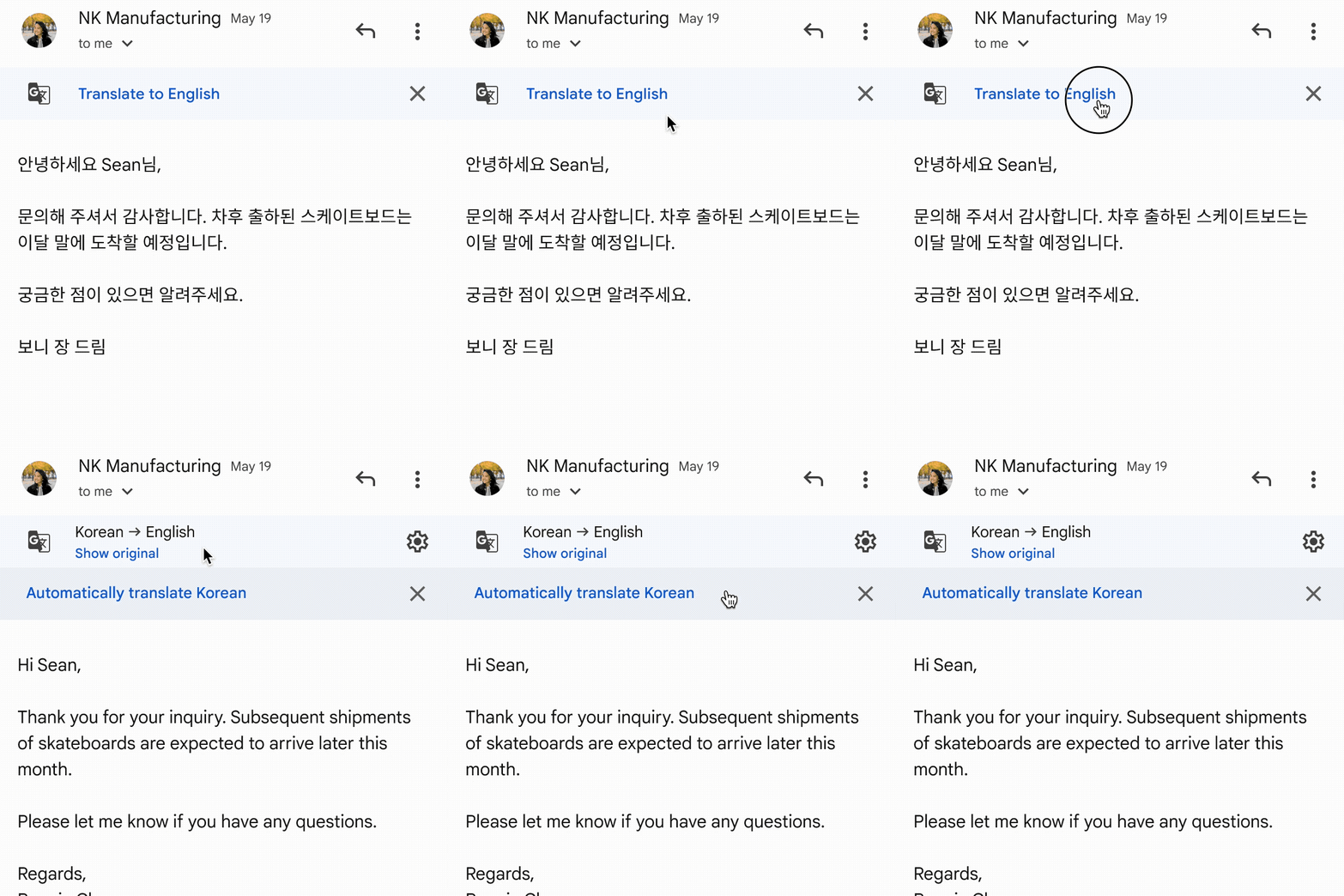
Original 8/8: Before the message body, Gmail will show a “Translate to” banner. Tapping updates what appears below with the ability to “Show original” again and “Automatically translate” a specific language going forward.
Press the settings gear to pick another output language, with over 100 supported. This prompt appears when the contents of an email doesn’t match your “Gmail display language,” which is the first dropdown menu in web app settings.
You can manually translate a language by going into the three-dot overflow menu in the top-right corner if an email was not recognized. The feature can also be disabled for a specific language by clicking ‘x’ on the banner and then “Don’t translate [language] again.”
Translations in Gmail for Android are rolling out from today onwards, while it will come to iOS in the coming weeks. This is a much-needed integration as users previously had to open an email on their computer, or taking a screenshot on mobile and send it to Google Lens or Translate.
Available to all Google Workspace customers and users with personal Google Accounts
In Python, dictionaries are data storage objects that use a key to retrieve a value. Think of your cell phone contact list or phone book. We look for the name of the person, the key, and their phone number is the value. Dictionaries are incredibly useful when storing and sorting data. We used a dictionary in our for loop project which saw RSS news feeds used to generate content on a web page.
We’re going to go through how to create, update and delete keys and values inside of a dictionary and then use a dictionary in a real world project where we create a notification system using Python and nfty.sh.
To demonstrate how to use Dictionaries in Python, we will use Thonny, a free, easy to use and cross platform Python editor.
1. In a browser go to the Thonny website anddownload the releasefor your system.
2. Alternatively, install the official Python releaseusing this guide. Note that this guide covers installation on Windows 10 and 11.
How To Create a Dictionary in Python
The most basic use for a dictionary is to store data, in this example we will create a dictionary called “registry” and in it store the names (keys) and starship registries / numbers (values) of characters from Star Trek.
1. Create a blank dictionary called “registry”. Dictionaries can be created with data already inside, but by creating a blank dictionary we have a “blank canvas” to start from.
registry = {}
2. Add a name and ship number to the registry. Remember that the name is a key, and the ship number is the value. Values can be strings, integers, floats, tuples, and lists.
Dictionaries are updatable (mutable in programming parlance) and that means we can update the key (names) and the values (ship numbers).
For our first scenario, we’ve had a call from Ben Sisko, and he wants his entry updated to Benjamin. We’re going to add this code to the previous example code.
1. Add a print statement to show that we are making updates. This is entirely optional, but for the purpose of this example it clarifies that we are updating the dictionary.
print(“UPDATES”)
2. Add a “Benjamin Sisko” key and set it to use the value stored under “Ben Sisko”.
4. Print the current contents of the registry. We can see that the “Ben Sisko” key is now gone, and is replaced with “Benjamin Sisko”. The value has also been transferred.
print(registry)
Next we will update the entry for James T Kirk. It seems that he has a new ship number (something to do with “accidentally” setting an easy password on his self-destruct app) and so we need to update the value for his entry.
1. Add a print statement to show that we are making updates. This is entirely optional, but for the purpose of this example it clarifies that we are updating the dictionary.
print("Kirk's new number")
2. Update the “James T Kirk” key with the new ship number. Note that because we are adding -A to the value, we have to wrap the value in “ “ to denote that we are now using a string.
registry["James T Kirk"] = "1701-A"
3. Print the contents of the registry. We can now see that James T Kirk has a new ship number.
Finally we need to delete Benjamin Sisko from the registry. It seems that he has gone “missing” while in the fire caves on Bajor. So we need to delete his entry from the registry. We’ll use the existing code, and add three new lines.
1. Add a print statement to show that we are deleting entries. This is entirely optional, but for the purpose of this example it clarifies that we are deleting entries from the dictionary.
print("Deleting Benjamin Sisko")
2. Delete “Benjamin Sisko” from the registry. We don’t know who the new captain will be yet.
del registry["Benjamin Sisko"]
3. Print the registry to confirm the deletion.
print(registry)
4. Save and run the code.
Complete Code Listing: Updating and Deleting a Dictionary
registry = {}
registry["James T Kirk"] = 1701
registry["Hikaru Sulu"] = 2000
registry["Kathryn Janeway"] = 74656
registry["Ben Sisko"] = 74205
print(registry)
print("UPDATES")
registry["Benjamin Sisko"] = registry["Ben Sisko"]
del registry["Ben Sisko"]
print(registry)
print("Kirk's new ship")
registry["James T Kirk"] = "1701-A"
print(registry)
print("Deleting Benjamin Sisko")
del registry["Benjamin Sisko"]
print(registry)
Using a For Loop With Dictionaries
For loops are awesome. We can use them to iterate through an object, retrieving data as it goes. Lets use one with our existing code example to iterate through the names (keys) and print the name and ship number for each captain.
1. Create a for loop to iterate through the keys and values in the registry dictionary. This loop will iterate through all the items in the dictionary, saving the current key and value each time the loop iterates.
for keys, values in registry.items():
2. Create a sentence that embeds the Captain’s name (keys) and the ship’s number / registry (values).
print("Captain", keys, "registry is", values)
3. Save the code and click Run. You will see the name and ship number for each captain printed at the bottom of the Python shell.
Complete Code Listing: Using a For Loop With Dictionaries
registry = {}
registry["James T Kirk"] = 1701
registry["Hikaru Sulu"] = 2000
registry["Kathryn Janeway"] = 74656
registry["Ben Sisko"] = 74205
print(registry)
print("UPDATES")
registry["Benjamin Sisko"] = registry["Ben Sisko"]
del registry["Ben Sisko"]
print(registry)
print("Kirk's new ship")
registry["James T Kirk"] = "1701-A"
print(registry)
print("Deleting Benjamin Sisko")
del registry["Benjamin Sisko"]
print(registry)
for keys, values in registry.items():
print("Captain", keys, "registry is", values)
Using Dictionaries in a Real World Project
(Image credit: Tom's Hardware)
We’ve learnt the basics, now lets use a dictionary in a real world project. We’re going to use ntfy.sh, a service to send notifications to Android and iOS devices. The Python API for ntfy.sh is based on dictionaries. Best of all, there are no Python installation files as it uses Python’s requests module to handle sending messages to ntfy.sh.
1. Install ntfy.sh for your Android / iOS device.
2. Open the app and click on + to create a new subscription.
(Image credit: Tom's Hardware)
3. Create a new topic and click Subscribe. We chose to use th-test. Create a topic that is personal to you. Also note that topics may not be password protected, so do not send sensitive data.
(Image credit: Tom's Hardware)
4. Leave the app open on your device.
Now our attention turns to our PC running Thonny.
5. Create a blank file.
6. Import the requests module. This is a module of pre-written Python code designed for sending and receiving network connections.
import requests
7. Use requests to post a message to ntfy. Note that we need to specify the topic name, in our case https://ntfy.sh/th-test, as part of the function’s argument. The next argument, data is the text that the user will see. But our interest is in “headers” as this is a dictionary which can contain multiple entries. Right now it contains a title for the notification.
requests.post("https://ntfy.sh/th-test",
   data="This is a test of ntfy for Tom's Hardware",
   headers={ "Title": "Python Dictionaries are useful" })
8. Save the code as dictionary-ntfy.py and click Run. This will send the message to ntfy’s servers and from there the notification will appear on your device.
Complete Code Listing: Real World Project
import requests
requests.post("https://ntfy.sh/th-test",
   data="This is a test of ntfy for Tom's Hardware",
   headers={ "Title": "Python Dictionaries are useful" })
An Advanced Real World Dictionary Project
(Image credit: Tom's Hardware)
Lets create a more advanced project, one that uses a dictionary to store multiple items. We’re going to reuse the code from before, but tweak it to meet our needs.
2. Open and read a file into memory. This is the data that is sent in the notification. In this case we start with an image that is in the same directory as our code. If the image is in a different location on your machine, specify the full path to the file.
data=open("yoga.jpg", 'rb'),
3. Create a dictionary called “headers”. This forms the information that is sent in the notification.
headers={
4. Inside the headers dictionary, specify the following keys and values.
Priority 5 messages are urgent, the highest priority and they will set your phone to vibrate / ring continuously until they are answered.
Tags: These are emojis and tags used to add icons and extra data to a notification. If the tag has an emoji, then you will see it.
Title: The top title, in bold for the notification.
Click: When you click on the notification, it will open the web page.
Filename: The name of the file that is being sent.
"Priority": "5",
"Tags": "rotating_light",
"Title": "Let me in, it is cold!!",
"Click": "https://www.tomshardware.com/reviews/elecfreaks-cm4-xgo",
"Filename": "yoga.jpg"
})
5. Save the code and click Run. Now look at your device and you will see a notification showing our custom message.
Complete Code Listing: Advanced Project
import requests
requests.post("https://ntfy.sh/th-test",
data=open("yoga.jpg", 'rb'),
headers={
       "Priority": "5",
       "Tags": "rotating_light",
       "Title": "Let me in, it is cold!!",
       "Click": "https://www.tomshardware.com/reviews/elecfreaks-cm4-xgo",
       "Filename": "yoga.jpg"
   })
More Python Tutorials
Les Pounder is an associate editor at Tom's Hardware. He is a creative technologist and for seven years has created projects to educate and inspire minds both young and old. He has worked with the Raspberry Pi Foundation to write and deliver their teacher training program "Picademy".
Editor’s note: The opinions of the smart, well-read women in my Denver book club mean a lot, and often determine what the rest of us choose to pile onto our bedside tables. Sure, you could read advertising blurbs on Amazon, but wouldn’t you be more likely to believe a neighbor with no skin in the game over a corporation being fed words by publishers? So in this new series, we are sharing these mini-reviews with you. Have any to offer? Email bellis@denverpost.com.
“People of the Book,” by Geraldine Brooks (Viking Penguin, 2008)
“People of the Book,” by Geraldine Brooks (Viking Penguin, 2008)
Having worked in a public library and a bookstore, I was frequently asked, “Can you recommend a good book?” One of my favorites is “People of the Book” for its rich imagined history of the actual Sarajevo Haggadah, an ancient Hebrew illuminated text. Hanna, a book conservationist, is hired to restore the book. While working on it, she discovers an insect wing, wine stains, salt crystals and a white hair. Each discovery takes the reader back to the time of each artifact and how it gets in the book. These travels introduce a period in history and the characters involved. Romance and intrigue are woven into the book and a twist toward the end brings a satisfying ending. – 4 stars (out of 4); Janice Volz Schefcik, Centennial
“Foregone.” by Russell Banks (Ecco, 2022)
While the framework is built around the deathbed confession of a habitual liar, the novel nakedly portrays the physical indignities of the last hours of the protagonist, who is dying of cancer. It also raises questions about the veracity of memory (doesn’t everyone remember things differently from others?) and the vagaries of individual truth, which can shift over time. — 2 stars (out of 4); Kathleen Lance, Denver
“The Liar’s Dictionary,” by Eley Williams (Doubleday, 2021)
Are you a lover of words? If so, glory in the wordplay of “The Liar’s Dictionary.” That’s fortuitous, as the mystery here is rather a slow burn. While I love the humor and the decisive writing, the richness of words a chocolate mousse to my mind, the dual storylines of dictionary contributors (one Victorian, one present day) never really engaged me. I had no trouble following it; I just kept waiting to care. – 3 stars (out of 4); Neva Gronert, Parker
“The Reading List,” by Sara Nisha Adams (William Morrow, 2021)
What a pleasure to read! Recently widowed Mukesh finds a list of books left behind by his late wife and goes to his local library to start reading them. His life starts to change in unexpected and hopeful ways. This is about the power of books to cement relationships and the building of community. A good read for bibliophiles! (Hint: You likely will have read most of the books on the list.) — 3 stars (out of 4); Susan Tracy, Denver
“The Commitments,” by Roddy Doyle (Vintage, 1989)
This novel offers a perfect balance of music, youthful enthusiasm, and sheer dumb luck. It follows talented, unemployed, working-class Irish as they create a soul band to make a living. Friend/manager Jimmy Rabbit says, “The Irish are the blacks of Europe; Dubliners are the blacks of Ireland; the Northside Dubliners are the blacks of Dublin … say it loud, I’m black and I’m proud.” They reach some success with the help of older musician, Joey, until the female members fall en masse for his charm, then succeed in falling victim to their own myth. An outstanding example of Irish charisma and blarney. (Editor’s note: Be sure to listen to the soundtrack to the 1991 film by the same name; it’s guaranteed to blow you away.) – 4 stars (out of 4); Bonnie McCune, Denver (bonniemccune.com)
Subscribe to our weekly newsletter, In The Know, to get entertainment news sent straight to your inbox.
The Gmail mobile app now allows users to translate emails directly within the app. Previously, this feature was only available on the web version of Gmail. The new feature is now rolling out to both Android and iOS devices.
In a blog post, Google stated, "For years, our users have been able to conveniently translate emails in Gmail on the web to over 100 languages. Starting today, we're excited to announce a native translation integration within the Gmail mobile app that will enable you to seamlessly communicate in a wide range of languages."
advertisement
The feature is aimed to help users This can be helpful if you receive emails in a language that you don't understand, or if you want to read an email in its original language but don't know the language.
With the new feature, the Gmail app automatically detects the language of the email content and displays a banner at the top of the email, offering to translate it into the user's preferred language. For example, if an email is in Spanish and the user's language is English, they can simply tap on 'Translate to English' to see the translated text.
The feature aims to help users. This can prove particularly useful when users receive emails in an unfamiliar language or wish to read an email in its original language despite not being acquainted with the language.
How to translate email in Gmail app
Open the Gmail app and open the email you want to translate.
Tap on the three dots in the top right corner of the email.
Select Translate.
Select the language you want to translate the email to.
The email will be translated and displayed in the new language.
If you dismiss the translation option, it will reappear when the app detects that the email's content is different from your set language.
You can also turn off the Translate banner. To turn off the Translate banner for a particular language, simply accept the "Don't translate [language] again" prompt that appears when you dismiss the banner.
Meanwhile, if the system fails to detect another language, you can manually translate the email using the option found in the three-dot menu.
Here are some additional things to keep in mind when using the new Gmail translate feature:
The translation functionality is currently in its beta phase, meaning there might be occasional inaccuracies or errors in the translated content.
Keep in mind that the translation might not be entirely precise, especially for technical or legal documents that require precise linguistic understanding.
The feature allows you to translate only one email at a time, so if you have multiple emails in a foreign language, you'll need to translate them individually.
Also, the feature will be available to users gradually, so if you don't see the feature in your Gmail app, update the app or wait for few weeks.
August is Women in Translation Month! So I figured I’d round up some of this year’s best crime novels in translation by women from around the world. Below, you’ll find Norwegian serial killers, Argentinian vampires, French influencers, South Korean lawyers, and so much more (honestly, a lot of French stuff—it’s been a really good year for French noir). A quick shoutout to the amazing publishers and translators who shepherded these works into a language I can read (although I did, once upon a time, read The Girl with the Dragon Tattoo in French. And some Simenon. Not to brag or anything).
Victoria Kielland, My Men Translated by Damion Searls
(Astra House)
Nasty, brutal, and short, Victoria Kielland’s My Men features Norwegian-American lonely hearts killer Belle Gunness, who lured widowers and their children to her farm with the promise of care and inheritable land, then slaughtered both her lovers and their families. The novel frames Gunness’ murderous quest as an almost-inevitable perversion of the American Dream. Kielland’s lyrical, abstract, and visceral prose, capably translated by Damion Searls, has won acclaim in her native Norway and is a beguiling match to her terrifying subject matter.
Mercedes Rosende, The Hand that Feeds You Translated by Tim Gutteridge
(Bitter Lemon)
Set in Montevideo, Uruguay, from where Mercedes Rosende also hails, The Hand That Feeds You is the sequel to Rosende’s much-lauded Crocodile Tears. Ursula, Rosende’s heroine, is now in possession of all the loot from an armored truck, with robbers, cops, and PIs hot in pursuit. Ursula has plenty of tricks up her sleeve, and given the ineptitude of her pursuers, she’s bound to triumph in the end, but how she does it? Comedic thriller gold.
Paula Rodriguez, Urgent Matters Translated by Sarah Moses
(Pushkin Vertigo)
In this perfectly paced and plotted Argentine thriller, a train crash is the opportunity one criminal needs to change his identity and go on the run. Unfortunately, one of the detectives hunting him just isn’t ready to let the case go, and he’s ready to use questionable methods to track down his target. What follows is one of the most delightful cat-and-mouse thrillers I’ve read in quite some time.
Mariana Enriquez, Our Share of Night
Translated by Megan McDowell (Hogarth)
What a strange and luminous novel. Mariana Enriquez stunned with her collection The Dangers of Smoking in Bed, and Our Share of Night is just as fantastic (and fantastical). Beginning in Argentina in the years of the dictatorship, Our Share of Night follows a father and son on a grief-driven road trip as they mourn the loss of the woman who united them, her dangerous (and possibly immortal) family close in pursuit. A dark vampiric noir that heralds a new era in South American horror.
Isabelle Autissier, Suddenly Translated by Gretchen Schmid (Penguin Books)
Isabelle Autissier has sailed the world alone, becoming the first woman to do so in a competition, and this survival thriller speaks to the experience of the author. In Suddenly, a French couple sets off on an epic journey, only to find themselves stranded on a remote island in the Antarctic Ocean. This is no Blue Lagoon or Robinson Crusoe—Autissier’s characters will be tested severely, and found wanting.
Pilar Quintana, Abyss
Translated by Lisa Dillman
(Bitter Lemon)
A young girl grapples with the complexities of the adult world in this moody psychological thriller. Her mother is deeply depressed, flourishing only when tending to her plants or in the arms of her lover, and her father is older, absent, and unable to process emotions. The father finds out about the lover, who disappears, and the family heads to a modern home in the Columbian mountains to recover their intimacy; the home, like the mother, is beautiful and cold, and its former mistress went out one night in her car and never returned…
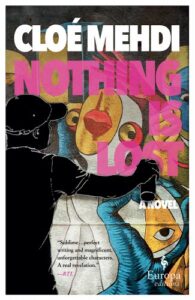
Chloé Mehdi, Nothing Is Lost Translated by Howard Curtis (Europa)
This pitch-dark French noir explores the aftermath of violence and the questions still unanswered in the wake of a teen’s murder by police. 11-year-old Mattia spends his days emotionally managing the adults around him, trying to keep his teachers from realizing he’s gifted, and thinking hard about the murder of 15-year-old Said during a police identity check. As he considers the life and death of Said, he puts together the larger puzzle of oppression in the heavily policed suburbs. Mehdi’s writing conjures the best of French noir, and reminds us why the French named the genre.
Maud Ventura, My Husband Translated by Emma Ramadan (HarperVia)
My Husband is a sly psychological thriller about a marriage that is not what it seems. A woman passionately in love with her husband keeps a detailed diary of his slights and insults, punishing him accordingly in the name of balance. Surprisingly comical and deeply insightful, My Husband is not to be missed.
Louise Mey, The Second Woman Translated by Louise Rogers Lalaurie (Pushkin Press)
The Second Woman is at once a chilling psychological thriller and a visceral exploration of internalized misogyny and the mechanics of abuse. The woman of the title is the new partner of a man suspected of involvement in the disappearance of his wife. When the wife returns, with seemingly no memory of him or her son, a game of cat and mouse begins, between the detective and the husband, and between the narrator’s wishful hopes and her slow acknowledgement of her dark reality.
Khadija Marouazi, History of Ash Translated by Alexander Elinson (Hoopoe)
Hoopoe Editions is dedicated to bringing English language audiences the best in Arabic literature, and History of Ash does not disappoint. In this devastating, lyrical novel of struggle, two prisoners in Morocco, a man and a woman, narrate their journey of resistance, imprisonment, and release during the “Lead Years” of the 1970s and 80s.
Leonie Swann, The Sunset Years of Agnes Sharp Translated by Amy Bojang (Soho)
Leonie Swann may write in German, but she’s set this darkly comic murder mystery in a retirement community in the English countryside. The inhabitants of Sunset Hall are shocked when one of them is murdered, then even more surprised when a detective comes by to investigate a different murder next door. Can they conceal the first body long enough to pin the murder on whoever was responsible for the corpse next door? And what does a tortoise have to do with it?
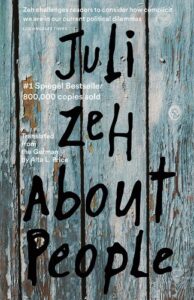
Juli Zeh, About People Translated by Alta L. Price (World Editions, October 3)
At the peak of the pandemic, a woman splits with her boyfriend over his increasingly rigid commitment to environmentalism and heads to the German countryside. The new home needs unexpected work, she and her dog promptly clash with their menacing neighbor, and unexplained things are happening all around her. This literary thriller is an intense exploration of fear and isolation.
Hye-Young Pyun, The Owl Cries Translated by Sora Kim-Russell (Arcade, October 3)
Hye-Young Pyun’s stunning psychological thrillers delve deep into the horrors of being human and the oppressive mechanics of modern society, and The Owl Cries demonstrates a writer at the top of her game. In The Owl Cries, a ranger has vanished from a mysterious forest and its secluded company town of loggers and researchers. His brother, a divorce lawyer, embarks on a lackadaisical investigation into the disappearance, but soon finds himself mired in the town’s corruption and enmeshed in its secrets.
Marie NDiaye, Vengeance is Mine (Translated by
(Astra House, October 17)
In Marie NDiaye’s sinister and spellbinding new novel, a lawyer is hired by the husband of a woman accused of murdering her three children, despite her lack of experience in high-profile trials. Meeting him unlocks memories for her of a childhood visit to a palatial home, perhaps occupied by the husband’s family, and wonders if she perhaps met her new client when she was 10 and he was 15. But what happened between them? And why can’t she remember the details? Half suspense novel, half dark fairy tale, Vengeance is Mine is a literary tour-de-force.
Delphine de Vigan, Kids Run the Show
Translated by Alison Anderson (Europa, November 28)
Damn, this book got dark. Like, you think it can’t get any darker, then it does. In Kids Run the Show, the younger child of a prominent mommy vlogger is kidnapped, and as the search continues, the reader begins to wonder if the child might be better off wherever they are than at home being constantly filmed. De Vigan has written a blistering critique of influencer culture, the erasure of privacy, and the exploitation of children. The prophetic ending takes us decades into the future to contemplate the psychological wounds of a generation raised to perform on the internet, for a deeply unsettling experience.