Saturday, January 22, 2022

An Indigenous warrior. An enduring mystery. A long-overdue translation - London Free Press (Blogs) - Translation

'All of the wisdom that is held in the language unlocks the key to culture and history of the Munsee people'

Article content

A longtime Southwestern Ontario mystery about a towering historical figure is at the heart of a new project designed to pique the interest of those learning to speak an endangered Indigenous language.

Advertisement

Article content

Educator Ian McCallum, who grew up listening to relatives converse in their native language of Munsee on Munsee-Delaware Nation near London, has finished the translation of a 1931 London Free Press article about the death and burial of Shawnee chief Tecumseh – and the mystery surrounding it – into that little-spoken language.

“I did some digging and I thought this would be a really good story to translate,” said McCallum, who lives near Barrie. He’s one of about three or four people who speak fluent Munsee as a second language and he teaches about 50 beginners, he said.

“We were looking for community stories to translate into the Munsee language, and I started with my own family because COVID didn’t allow for a lot of communication with the elders.”

Advertisement

Article content

In the 1931 Free Press story, McCallum’s great-great uncle, Jacob Logan, described the death and burial of Tecumseh, who was killed near Chatham in 1813 while fighting for the British in the War of 1812.

The final location of Tecumseh’s body has long been debated, with some believing his corpse had been secretly disposed of by his own warriors. Logan, who died in 1935 at age 100, recounted in the article having overheard as a 14-year-old where Tecumseh was buried.

At that time, the Logan family’s cabin – which still stands in the Longwoods Conservation Area near Delaware – was visited by a group of War of 1812 veterans, including an Indigenous man named Jacob Fesson, McCallum said.

Logan’s mother told him to go upstairs but, recognizing the importance of their visit, told her son to keep his ears open.

Advertisement

Article content

Fesson told the story of Tecumseh’s death near Thamesville and how he and other Indigenous warriors had been instructed by the revered chief to hide his body from the enemy after he had been shot and wounded – an event he had foreseen in three dreams – during a battle.

The men used their tomahawks to dig a grave at the roots of a toppled tree and, once buried with his weaponry, the warriors covered it back up with the roots of the tree to avoid detection, Logan said.

Logan later attempted to find Tecumseh’s burial place.

“The topography of the land had changed so much from when he heard the story, so was unable to do so,” McCallum said.
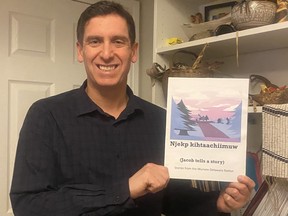
Ian McCallum is shown with an early draft of his book, a translated-into-Munsee retelling of a 1931 London Free Press article about Tecumseh.

McCallum, 50, is an education officer with the province’s Indigenous education office. He says many Munsees lost their language due to residential schools, where anything but English was prohibited.

Advertisement

Article content

The translated account, which will soon be made into an illustrated book, is designed to mark the start of the United Nations International Decade of Indigenous Languages, McCallum said. He hopes school boards and others will use it as a learning tool.

“All of the wisdom that is held in the language unlocks the key to culture and history of the Munsee people,” said McCallum, who also regularly tweets in Munsee under the user name @IanMcCallum3.

The Munsee people settled in southern Ontario after being pushed out of the east coast of the United States by colonists and settlers in the 1780s. McCallum’s ancestors settled on the Munsee-Delaware reserve, about 25 kilomeres southwest of London.

The son of an English immigrant father and Munsee-Delaware mother, McCallum split his time growing up between Munsee-Delaware and Barrie, where his father taught school.

Advertisement

Article content

After graduating from teachers college at Queen’s University, McCallum was required to take a course at Western University, which had just begun to teach the Mohawk language. After picking up a Munsee-English dictionary, he found a teacher at Moraviantown, another Munsee settlement in Chatham-Kent, and spent a couple of summers learning the language.

“I re-learned the language from that speaker,” said McCallum, who first learned to speak the language as a child.

Munsee is one of more than half a dozen Indigenous languages considered at risk in Southwestern Ontario. Others are:

  • Oneida
  • Ojibway
  • Ottawa
  • Mohawk
  • Cayuga
  • Onondaga
  • Seneca
  • Cree

HRivers@postmedia.com

Advertisement

    Advertisement

    Adblock test (Why?)

    Last in translation | NCPR News - North Country Public Radio - Translation

    Photo: Mitch Teich" href="https://www.northcountrypublicradio.org/news/images/sehrklug.png">

    I'm not sure I would go *that* far.
    Photo: Mitch Teich

    You might have missed the moment when it happened. 

    It was around 11:30 in the evening, and I asked how much the coffee cost.  I didn’t get an answer, but my phone played a fanfare, which was really the response I was looking for. And with that, the odometer on my Duolingo app rolled over to 1825 days.

    Duolingo, if you’re not acquainted, is a language learning app.  And 1825 days, if your math is as slow as mine, is five years.  I’ve spent a few minutes dusting off my foreign language skills every day since January of 2017.

    It started with practicing my French, under the misguided belief that I could keep up with my daughter, who was studying French using a little technique called “school.” I, too, had taken French in my school days – six years’ worth, spanning the gamut of 1980s French instruction, from confidently expressing that my name is Mitch, to learning the days of the week, to reading L’Etranger with marginal comprehension.  For example, I could understand if one of the characters introduced himself on a Wednesday.  To me, that seemed like the shortcoming to school language instruction in those days – we never knew whether we were learning French to order crêpes, or so that we could read early 20th Century literature.

    But by 2017, I could no longer even count on my introductory skills, and would have been in big trouble if I had been cornered in an alley by thugs who demanded that I translate Camus for them.  So I hopped on the Duolingo train, and before you could say bibliotheque, my then-seventh grade daughter could talk to me in patronizingly short words.

    But I kept it up, and gradually picked up some useful words and phrases, just enough to chaperone an eighth grade trip to French language camp in Minnesota, and then foolishly decline the damage waiver at the rental car counter at Charles de Gaulle Airport a few months later.  And before you knew it, I moved to a place just a half-hour from the Quebec border, where knowing French could be a regularly useful skill.

    And so I switched to German. 

    My daughter, having gotten well beyond the point of personal introductions and days of the week in French, had decided that she could someday become ambassador to Switzerland, so she added German to her skill set, progressing quickly enough that she can now correct the subtitles on disturbing German dramas on Netflix.  My wife had taken German in high school, and so I was facing the real possibility that I would soon no longer understand the women in my household, both metaphorically and literally.

    A few hundred days of Duolingo later, I can order coffee from an imaginary barista on an app, tell our dog to get on with her business already (Lass uns gehen, Muesli, es ist kalt!), and understand many of the lyrics in German pop songs, if not always the context. (Yes, but why do the singers believe the best is yet to come?).  It hasn’t been amazingly practical, but it has been fun to pick up a language from das Erdgeschoss – er, the ground floor. 

    Moreover, I work in the media business, emailing public radio colleagues, writing a column, or interviewing musicians every day.  And so the act of spending a few minutes each day deliberately thinking about the skill of language has been time well-spent.

    So I’m keeping up my Duolingo streak, even if I’m only on Level 3 of “Dining Out” and Level 2 of “Health.”  My wife and daughter still have plenty of ways of communicating without my understanding. 

    But I have reason for hope. My son started French this year.

    Adblock test (Why?)

    "Don't mention the war!" entering the Dutch dictionary - NL Times - Dictionary

    "Don't mention the war!" entering the Dutch dictionary | NL Times Skip to main content

    Adblock test (Why?)

    Friday, January 21, 2022

    "Just keep saying it, we will understand": Elders compile Shoshone dictionary - Wyoming Public Media - Dictionary

    Shoshone Elder Ula Tyler has been a participant for the last two weeks in the tribe's efforts to create a dictionary with all six different clan dialects. Tyler was a Shoshone Language teacher on the Wind River Reservation for decades and has extensive knowledge of the language. She said some of her earliest memories are learning Shoshone with her mother.

    From her years as a teacher, she would encounter students who were shy or were scared of messing up when trying to speak Shoshone, and she would try and encourage them.

    "Keep saying it. You'll learn it. You don't have to be ashamed of it, it's our language. We will understand what you are trying to say," she said.

    During the run of the project, Tyler was responsible for recording around 200 words in a single day.

    The process is called Rapid Word Collection. There are group stations, typically two to three elders per group. Elders are assigned topics that range from as big as the universe or what to call different types of animals. And they think and talk with other elders about what words they know.

    Robyn Rofkar is with the Shoshone cultural center in Fort Washakie. She applied to receive grant funding to put on the two-week-long event.

    "And it's sad to say, but where, you know, every year, we lose more and more fluent speakers, which is like losing a whole Encyclopedia of knowledge. So time is of the essence. It always has been," Rofkar said.

    There are about 200 fluent Shoshone speakers in the forty-five hundred member tribe and most of them are over the age of sixty. And since every Indigenous community was hit hard by the pandemic, the Shoshone have lost several very valuable speakers.

    A woman wearing a mask speaks to a linguist virtually

    Taylar Stagner

    /

    Wyoming Public Radio

    Carmen Thomas (Shoshone) talks with linguists virtually about the language project.

    The reason the language is disappearing was that many were discouraged from speaking their native languages due to assimilation tactics like in Indian Boarding Schools, and it wasn't until 1978 when the Native American Religious Freedom Act was passed that protected traditional aspects of Indigenous culture including traditional language.

    However, generations of Indigenous people have lost contact with their language.

    Rofkar said now there is a growing number of younger Shoshone people who want to learn more, but may not have access to the language in a few years. The local schools have limited time for Shoshone Language Classes.

    "We need to do more to help the younger generation be able to learn it," Rofkar said.

    She said that once the dictionary is done, the cultural center wants to develop a phone app to help tribal members learn the language.

    This issue has been worked on before but previous recordings seem to have disappeared. Their goal is to not let that happen again.

    "[The] Eastern Shoshone tribe is the actual grantee of the grant and everything we do will be here, will be owned by the Eastern Shoshone tribe," she said.

    The Language Conservancy, the non-profit helping put together the dictionary, does not own or copyright any of the work being done during the project, so future projects like creating an app will be completely under the Eastern Shoshone control.

    William Meya is the director of The Language Conservancy and said that their organization has worked with over 50 endangered languages internationally, and said now is the time to collect words for the younger generation.

    "So, there's not a lot of time left for Shoshone and we want to make sure that as much of the language is available for those young people that decide to learn it," Meya said.

    Meya also said that puts the Shoshone language in a unique position because of the advanced age of many of the elders on the project, and Meya says that in the next five to 10 years many won't be available anymore.

    "I was very surprised at the age of the speakers. Of course, they are excellent speakers and have a fantastic knowledge of their language, which is incredible, and a privilege to be a part of working with speakers that are 98 years old 91 years old, many in their late 80s," he said.

    The workshop collected around six thousand words for the dictionary and accompanying app that should be released in the next year.

    Adblock test (Why?)

    Pointless Theatre returns to stage with new translation of 'Rhinocéros' - DC Metro Theater Arts - Translation

    Pointless Theatre is thrilled to announce their first in-person programming since the summer of 2019 — an original translation of Eugene Ionesco’s seminal play Rhinocéros.

    First produced in 1959, Rhinocéros presents a small town overrun with radical ideas, clashing ideology, and not-so-subtle transformations. When Bérenger, a local drunk, finds himself surrounded by neighbors who are slowly turning into giant beasts, he’s forced to navigate a new world where the rights of citizens are changing as rapidly as the body of the mob around him.

    While the original script serves as an allegory for the rise of fascism in mid-20th-century Europe, the story presents a familiar tone in public discourse and examines the ways in which a public is quickly radicalized.

    Pointless adds an exclamation mark to Ionesco’s title: Rhinocéros! Company Member Frank Labovitz helms the project as director and translator. A Helen Hayes Award–winning costume designer, Labovitz brings a sculptor’s eye to the production. “Ionesco’s absurdist look at communities in conflict offers a great opportunity to visualize the kind of radical transformation we’ve seen over the past two years,” says Labovitz. “Representing these transformations with bold designs is the true challenge of this piece.”

    Long known for smashing the boundaries between puppetry, music, dance, and the visual arts, Pointless will bring a fresh aesthetic approach to this absurdist touchstone. Employing large-scale puppetry to represent the transformation of people to beast, the production will confront audiences face to face with a cast of life-size creatures.

    Performing for the first time in the venue below the Universalist National Memorial Church (1810 16th St NW, DC), the company welcomes audiences to their new home base. “We are pleased to be sharing a space that has been cultivated by other small companies like Spooky Action Theater,” says Matthew Reckeweg, the company’s producing artistic director. “Entering our 13th year with a fresh start, and in a new space, reflects the excitement our artists feel returning to the stage after a long hiatus.”

    Rhinocéros! begins previews on March 26, opens April 1, and runs through April 24, 2022, at Universalist National Memorial Church, 1810 16th St NW, Washington, DC. A PWYC performance will take place April 7, 2022. Tickets are on sale now ($22 for students and seniors, $30 for general admission). To purchase, and for more information, visit pointlesstheatre.com.

    Running Time: Approximately 80 minutes with one intermission.

    COVID Safety: Proof of full vaccination is required for entry. Masks are required when not eating or drinking. Pointless Theatre’s ticket policies and COVID protocols are here.

    Adblock test (Why?)

    Thursday, January 20, 2022

    COVID-19 keeps transforming our language - wgbh.org - Dictionary

    As we hit the second anniversary of the first confirmed U.S. case of COVID-19, the pandemic continues to impact our day-to-day life in ways big and small, right down to the very language we use.

    Among hundreds of new terms added to Merriam-Webster's online dictionary in 2021, a significant number of them were coined during the ongoing pandemic.

    Related Stories

    "We saw the word long hauler added to the dictionary," said Merriam-Webster editor-at-large Peter Sokolowski. "There’s super-spreader and long COVID, vaccine passport and vaccine hesitancy."

    Sokolowski said that COVID-19 also made its mark among thousands of old words that received new definitions in 2021— including "pod," "bubble" and "breakthrough."

    "Breakthrough is a word that has existed for hundreds of years in English," he said. "But now we use it to refer to an infection occurring in someone who is fully vaccinated against an infectious agent, as in ‘breakthrough cases’ or ‘breakthrough infections.’"

    But it wasn’t all about the coronavirus in 2021. A number of terms that reflect the zeitgeist were added, too, including “cancel culture,” “gig worker” and the acronym "BIPOC."

    Acronyms, and their cousins initialisms, have increasingly made their way into the dictionary. Initialisms are similar to acronyms, but rather than the letters being pronounced as a word, like LASER or SCUBA, each letter is pronounced, like two new entries in 2021: TBH — to be honest, and FTW — for the win.

    The trend of technology inspiring new entries also continued in 2021. Terms added include “deplatform” — to remove and ban (a registered user) from a mass communication medium (such as a social networking or blogging website), and “digital nomad” — someone who performs their occupation entirely over the internet while traveling.

    "There’s also the term 'bitrot,'" said Sokolowski. "So, digital culture has come so far in the last 20 to 30 years that we’re now talking about the erosion or degradation of digital culture. Bitrot: the tendency for digital information to degrade or become unusable over time."

    Food words are also often a big driver of new dictionary entries. And a culinary term near and dear to many here in Massachusetts since at least 1960, when it was first trademarked, was finally added in 2021: That magical concoction of peanut butter and marshmallow once dubbed the "liberty sandwich" but today known the world over as the "fluffernutter."

    Each year, the folks at Merriam-Webster select a “word of the year,” and Sokolowski said there were a few candidates in 2021. The word “insurrection” saw an extraordinary surge of interest in January — a 60,000% increase in lookups over the same time period in 2020.

    Another contender was the word "infrastructure," a topic hotly debated in the halls of Congress for much of the year.

    "The debates often were about the definition," said Sokowski. "They were about what infrastructure is. Does it include broadband, does it include medical care? Does it include childcare?"

    Merriam-Webster defines it as "the basic equipment and structures (such as roads and bridges) that are needed for a country, region, or organization to function properly."

    Despite the fact that it’s comprised of two Latin root words, infrastructure is a thoroughly modern term, coined by NATO and U.S. military forces as they led a rebuild of Europe following World War 2. In that sense, it's always been a political term.

    "That term was then brought back to the United States to talk about the domestic agenda of President [Dwight] Eisenhower who was in the process of building our Interstate Highway System," explained Sokolowski.

    But in the end, Sokolowski said the word of the year was always clear; one that saw record online traffic throughout the year and totaled more than a billion lookups: "vaccine."

    "In the case of vaccine, we actually have a double story," said Sokowski. "There’s the medical story of the innovations and the mRNA vaccines for this particular coronavirus. But then there’s the second story, which is about mandates, about politics, really."

    Adblock test (Why?)

    Sheikh Zayed Award partners with literary organisations to support translation programme - The Bookseller - Translation

    The Sheikh Zayed Book Award (SZBA) is partnering with the British Centre for Literary Translation (BCLT) and the National Centre for Writing (NCW) to support an Arabic to English translation programme. 

    The partnership aims to "strengthen cultural dialogue and promote the award’s translation grant", and will be rolled out through an 18-month programme, providing access to a network of Arab translators in the UK.

    As part of this, the SZBA will support a literary translation workshop during the BCLT's International Literary Translation and Creative Writing Summer School, which runs from the 18th to 22nd July 2022. The one-week programme will bring together writers and translators from around the world with literary translator Nariman Youssef, director of Arabic translation at the British Library, as moderator.

    The SZBA will also support a mentorship scheme for one emerging Arabic to English translator and a six-month orientation programme for an emerging professional literary translator.

    Dr Ali bin Tamim, chairman of the ALC and secretary-general of the SZBA, said the initiative will "strengthen collaborative efforts with our partners in the UK to promote Arabic translation around the world" and "expand the scope of cultural exchange between the East and the West by translating notable literary works that advance the Arabic language on the global stage, and promote its greatest works among non-Arabic speakers".

    The long-term initiative will provide access to an extended network of translators and academics in the United Kingdom to encourage more interest in the translation grant and Translation category of the SZBA. It is designed to create an alumni network of Arabic literary translators in the UK, develop an initiative in collaboration with the British Centre for Literary Translation, and publish an Arabic anthology that includes works by graduates from the centre’s summer school, as well as interns.

    Professor Duncan Large, academic director of the BCLT, added: "we are delighted to be collaborating with the Sheikh Zayed Book Award in offering this exciting professional development opportunity to Arabic-English literary translators. We look forward to hosting an Arabic-English translation workshop at our annual Summer School for the first time in over a decade, and this initiative will enable translators to attend, irrespective of their circumstances."

    A statement by the National Centre for Writing said: “We are very pleased to participate in organising this programme with the Sheikh Zayed Book Award to offer a talented early-career Arabic-English translator a place on our Emerging Translators Mentorship Scheme in 2022," said a spokesperson for the NCW. 

    "We thank the Sheikh Zayed Book Award for its support, enabling us to work together with BCLT to nurture a new generation of literary translators from Arabic into English.”

    The BCLT is a research centre affiliated with the University of East Anglia, where it supports a Master’s degree in literary translation and a doctoral research programme. 

    The annual SZBA award is one of the Arab world’s most prestigious literary prizes, and recognises the work of writers, translators, researchers, academics and publishers in advancing Arab literature and culture.

    Adblock test (Why?)