Tuesday, June 1, 2021

Einstein's garden: translating physics into Blackfoot | symmetry magazine - Symmetry magazine - Translation

In 2015, the Laser Interferometer Gravitational-Wave Observatory detected massive ripples in spacetime caused by the collision of two black holes. It was the first direct observation of gravitational waves, sought by physicists since Albert Einstein predicted their existence in 1916. 

LIGO scientists prepared to announce the enormous discovery to the world. Translators worked to rewrite the embargoed press release in Chinese, French, Hindi and Korean (to name only a few). 

Corey Gray, a detector operator at LIGO’s Hanford Observatory in Washington, proposed adding another language to the collection. He suggested that his mother, Sharon Yellowfly, might be able to translate the press release into Blackfoot, the Algonquin language spoken by the Siksika, Kainai, Piikani and Blackfeet, the four bands of the Indigenous Blackfoot Confederacy of North America.   

It was the first press release announcing a result that would earn scientists a Nobel Prize to be translated into Blackfoot. And it was a high-profile demonstration of the way Yellowfly and other members of the Siksika Nation work to reinvigorate a language that was for over a century purposefully pushed to the edge of extinction.

A process of assimilation

The Blackfoot people live in the Northern Great Plains, in what is now Alberta, Canada, and the US state of Montana—though early on, their territory was larger, spanning northern Saskatchewan to northern Wyoming. 

Almost as soon as Europeans arrived with intentions of colonizing the land, they established day and boarding schools for Indigenous children. The purpose of these schools was to strip the children of their cultures, including their languages. 

As the 2015 report of the Truth and Reconciliation Commission of Canada put it: “These measures were a part of a coherent policy to eliminate Aboriginal people as distinct peoples and assimilate them into the Canadian mainstream against their will.” The government supported these efforts, eventually mandating every Indigenous child attend one of these schools, because “[i]f every Aboriginal person had been ‘absorbed into the body politic,’ there would be no reserves, no Treaties, and no Aboriginal rights.”

As a child in Canada in the 1960s, Yellowfly was forced to attend a Christian boarding school for Blackfoot children. She was separated from her family and her culture and physically punished for speaking her own language. 

As the Truth and Reconciliation Commission report notes, many children did not survive the abuse they experienced at the schools. Yellowfly made it through, leaving school in her senior year. 

When she was 23 years old, living in California, she started “just copying down [Blackfoot] words” she heard from her parents and elders, she says. At first, she was just trying to collect words on paper for her children. But soon she had the idea to do something more.

“A lot of the little kids weren't speaking Blackfoot at all, and at some point, I thought, there will be a need for a dictionary. When the elders pass, a lot of what they know and have experienced will be gone.”

Several decades later, her dictionary has grown quite large. And now she is one of the elders adding new words to its pages.

Speaking of physics

In polysynthetic languages such as Blackfoot, most words are made up of smaller word bits called “morphemes.” The word ‘snack’, for example, translates in Blackfoot to ‘a'písttaapiksistaki’, a combination of morphemes meaning “move about tasting food.” 

Languages with hundreds of millions of speakers are constantly evolving, adding new terms as people find new ways to express themselves. But native Blackfoot speakers number in the few thousands, so terms for concepts such as “Einstein’s theory of general relativity” and “gravitational waves” had yet to catch on. 

Yellowfly took some poetic license in the LIGO press release she translated. She referred to Einstein’s theory as bisaatsinsiimaan, or "beautiful plantings.”

“Trying to explain his theory would have probably taken three to five pages in Blackfoot,” she says. “I thought ‘beautiful plantings’ was appropriate because there are so many things coming from this theory, and I’m sure there will be more. ‘Plantings’ was the word for it; they’re harvesting from that garden.”

Yellowfly has kept up the effort to translate announcements related to gravitational-wave detections. In the process, she has created new ways to express concepts including “plot,” “inspiraling,” and “percentages.” 

Some words and phrases can be directly translated—“black hole” is simply the Blackfoot words for “black” and “hole”—and other translations are more conceptual. Her word for “gravitational waves,” for example, translates to “stick-together waves.” 

“I think of what she does as poetry,” Gray says. “I always love hearing the new words that she comes up with.”

Helping a language to thrive

“Humanity is facing a massive extinction,” according to the Endangered Languages Project, managed by First Peoples’ Cultural Council and a team at the University of Hawai’i at Mānoa. “[L]anguages are disappearing at an unprecedented pace. And when that happens, a unique vision of the world is lost. 

“With every language that dies we lose an enormous cultural heritage; the understanding of how humans relate to the world around us; scientific, medical and botanical knowledge; and most importantly, we lose the expression of communities’ humor, love and life.”

Indigenous language revitalization is an important effort in the 21st century, says advocate Kanentogon Hemlock. And the best way to revitalize a language is to use it. 

“You have to try to bring the language into what you do: into the activities, into the work that’s being done,” he said in an online livestream for the Canadian education organization Think Indigenous. 

Continuing to use it in everday life doesn’t just revitalize only the language, he said—“Language forms the way that we think and the way that we see the world. So by bringing language back to everything that we do, it’s also reinvigorating our way of life.”

Modern examples of efforts to bring endangered languages into regular use are multiplying: Cartoons, video games, and movies (including Star Wars and Finding Nemo) have been translated into Indigenous languages. In 2019, a hockey game broadcast in Canada was commentated in another Algonquin dialect, Cree; in January 2020, another hockey game was commentated in Blackfoot. Blackfoot speakers are teaching others digitally via YouTube channels, apps and virtual guides, and in-person in programs at schools and universities.

Gray says he would love to recruit people from other tribes to translate LIGO’s findings into even more languages. “Indigenous languages have been hammered away for so long,” he says, “but the fact that they’ve survived shows the resilience of Indigenous peoples, and my mom is a perfect example of that.”


Microsoft Teams update to add a new message translation feature on iOS & Android - Republic World - Translation

Microsoft has been taking some really cool decisions when it comes to updating its open-source platform, Teams. Recently, the organisation is reportedly working on a new feature that could transform how companies are handling working from home over the last year. The Microsoft Teams update is going to bring a message translation feature into the app so that the language barrier is no more a problem. If you are intrigued by this feature, then do not worry, here is all you need to know about it.

Details about Microsoft Teams message translation update 

As we all know that the coronavirus pandemic has affected our lives drastically and now most of the offices around the world are working remotely. So, with the help of the Teams app, companies are able to resume work despite all the challenges they face. Now the new in-line message translation feature is going to transform business communication. According to two entries from the company’s product roadmap spotted by Techradar, the Teams app for Android and iOS devices will start displaying in-line translations that will quickly translate posts in their channels in the language of their choice. 

This will help companies that have a large team spread across countries. It will also eliminate any sort of confusion. With this new feature, businesses will also be able to hire people or contact other companies from different countries without having to wonder about language barriers. Besides channel posts, the new message translation feature will also translate replies for the users in their preferred languages.

The update is still in the works, but it is expected to arrive soon on the Teams app for mobile devices. Tech enthusiasts believe, that users might get this feature rolled out on their devices in July, but there is no certainty. Currently, it is tested by the company, but as per the reports, using this new feature will be quite easy. Users who would want a certain message to be translated just have to press and hold a message, and tap the “Translate” option. The system will immediately provide you with the translation as per the default language you have selected. 

IMAGE: SHUTTERSTOCK 

Stonewall founder thinks the dictionary's definition of freedom is 'ludicrous' - PinkNews - Dictionary

Simon Fanshawe. (Getty/ David M Benett)

Stonewall founder Simon Fanshawe has said it’s “ludicrous” that freedom for trans people would mean, well, the dictionary definition of freedom.

Fanshawe, who in 2019 signed an open letter declaring the charity undermines “women’s sex-based rights” by supporting Gender Recognition Act reform, was one of the 14 people who formed Stonewall in 1989.

According to the Collins English Dictionary, freedom is defined as “the state of being allowed to do what you want to do”, but Fanshawe appears to think this definition is “ludicrous”.

In an op-ed for the Daily Mail, he wrote: “‘Free to Be’, Stonewall’s new slogan claims. It is a ludicrous notion that freedom means that you can just be whatever you want.

“True freedom comes from respecting other people and finding ways to live harmoniously together.

“How bitterly ironic that the only freedom Stonewall won’t embrace is the freedom to disagree.”

Fanshawe insisted that Stonewall “has become single-mindedly focused on a particular and by no means universally accepted approach to trans rights”.

Recalling the good old days before trans people were even included in the charity’s work, the Stonewall founder said: “The lesbians, gays and bisexuals (it used, after all, to be just ‘LGB’ before it became ‘LGBTQ+’) that Stonewall was set up to defend have been all but abandoned by an organisation now pushing a divisive dogma.

“I have watched all this with mounting anger and sorrow but also fear, because this is not a minor chapter in the culture wars, but something that affects every single person living in the UK today.”

Fanshawe cited the fact that equalities minister Liz Truss is encouraging government departments to withdraw from the Stonewall Diversity Champions programme as proof that “many gay and trans people” were “alarmed” by the charity’s pro-trans rights stance and support of self-identification.

He said his criticisms of the organisation were “painful” to express, and went on to describe all of the amazing successes Stonewall has contributed to for gay, lesbian and bisexual people in the UK.

In an unintentionally ironic statement that could just as easily be applied to trans rights, he added: “We did not ask for more than straight people had, nor did we want them to give anything up. In the end, it was simply a question of fairness: a virtue the British have always prized.”

Last month, Stonewall chief executive Nancy Kelley addressed criticism by Fanshawe and another Stonewall co-founder, former Tory MP Matthew Parris, over the charity’s support of trans rights.

She wrote on Twitter that there had been a lot of “media covering the fact that a couple of our founders think we shouldn’t advocate for the rights of trans people”, and added: “Founder syndrome is a whole thing in charity world… The baby grew up, you see, and it didn’t grow up into quite the person they imagined.”

She added that the “surprising thing” about Stonewall’s founders was “not that a couple of them disagree with our inclusive stance, but that “so many of them are still right by our side” and are “powerful, compassionate activists for all LGBTQ+ people” 32 years on from its founding.

Using Google Translate to Autogenerate Content? - Search Engine Journal - Translation

Google’s Mueller was asked a question about using Google Translate to create content in another language. He suggested there may be a quality issue and expanded his answer to reframe the issue as being about spam.

Is Content Created With Google Translate Considered Duplicate?

The person asking the question first said that he wanted to convert an English language site to German and asked if there would be any problems related to duplicate content.

The first question:

“…I have an English website. So now I want to make a German website. I want to ask this question about duplicate content issues.

So I have German content. Then… suppose use a translator like Google Translate to translate. So will Google tell me it is duplicate?”

Mueller answered:

“No. If it’s translated content it’s not duplicate content.”

He next addressed the issue of using Google Translate for creating the German content from English content.

John Mueller:

“I think that’s a different problem then, though.

So just in general, translated content is unique content. It’s different words, different letters on the page, so it’s different content.

Depending on how you translate it, that would be more of a quality issue.

So if you use an automatic translating tool and you just translate your whole website automatically into a different language then probably we would see that as a lower quality website because often the translations are not that great.

But if you take a translation tool and then you rework it with maybe translators who know the language and you create a better version of that content, then that’s perfectly fine.”

Advertisement

Continue Reading Below

Google Translate Content Can Lead to Manual Actions

What’s interesting is how Mueller reframed the idea from the point of view of autogenerating content.

Mueller turns this into something that is about more than the somewhat vague concept of “quality content,” it now becomes about violating one of the big spam rules, which is the prohibition on publishing autogenerated content.

This is now a conversation that is clearly about spam.

John Mueller continued his answer:

“And I imagine, over time, the translation tools will get better so that it works a little bit better. But at least for the moment, if you just automatically translate it, from a quality point of view, that would be problematic.

And even a step further, if that’s something that is done at scale, then the web spam team might step in and say, this is automatically generated content, we don’t want to index it.”

The person asking the question then suggested doing a translation and having a freelancer redo the content.

Advertisement

Continue Reading Below

Mueller replied by discussing quality in content.

He answered:

“I think that’s a good start. But I think you have to consider the quality aspect.

Just like what kind of content you would expect in your own language.

Like if you’re searching in your language and you find a page and you read it,and it’s like…”

At this point Mueller shook his head to visualize the response of a user to low quality content.

Google’s John Mueller Illustrating Response to Poor Quality Content

Google's John Mueller shakes head to illustrate response of someone to poor quality contentJohn Mueller shakes his head to illustrate the response of a user to low quality content

Mueller continued:

“I don’t know who wrote this. This doesn’t make much sense. Then you wouldn’t trust that page, right?

Essentially it’s the same thing. You’re creating content for German users and if they look at it and say, “oh, this doesn’t make much sense then they’re going to go somewhere else.”

Google Translate for Autogenerating Content Can Result in Manual Action

John Mueller did not encourage the person to use Google Translate for creating content in different languages.

Google Translate works great for communicating the meaning of a page but it is not a perfect translation and it really does read awkwardly.

It’s easy to understand that using Google Translate for content creation might not be a good idea just because of the content quality issue.

John Mueller took the answer a step further by suggesting that using Google Translate at scale could result in a manual action for autogenerated content.

Citation

Watch Mueller answer question about using Google Translate to create website content

Advertisement

Continue Reading Below

Discussion begins at the 5:44 minute mark

Controversial Dutch Language RFP Begins; USD 40m Translation Contract Up for Grabs - Slator - Translation

2 mins ago

Controversial Dutch Language RFP Begins; USD 40m Translation Contract Up for Grabs

The controversial language services tender managed by the Dutch Ministry of Justice has started to see the light of day with the publication of at least one announcement for translation services on May 11, 2021.

Worth an estimated EUR 32.98m (USD 40m), the contract is slated for two years plus “the period before implementation” (pegged at five months), and may be extended for another two, maximum. Proposals must be submitted in Dutch by July 23, 2021.

Slator first began covering this Dutch Justice Ministry tender, comprising some 20 translation and interpretation contracts, a year ago. Originally scheduled to begin in October 2020, according to a source at the Ministry’s Legal Aid Board (RvR), the tender process was pushed back to 2021.

Advertisement

More recently, another source close to the matter told Slator that the Justice Ministry had begun to contact translators and interpreters before the new year for assignments with the National Police (for phone interpretation), RvR, Central Agency for the Reception of Asylum Seekers, Immigration Service, and several government agencies.

Slator 2021 Language Industry Market Report

Data and Research, Slator reports

80-pages. Market Size by Vertical, Geo, Intention. Expert-in-Loop Model. M&A. Frontier Tech. Hybrid Future. Outlook 2021-2025.

The EUR 32.98m Justice Ministry translation contract covers written translations plus the so-called “value-added services” of editing and the transcription of sound clips. The contract also includes “the recruitment, selection, and training of translators” so they can be included in the Register of Sworn Interpreters and Translators (Rbtv). In other words, any translator given an assignment under the contract must be a sworn translator.

Moreover, translators hired by the chosen language service providers (LSPs) “must have a good command of Dutch, both spoken and written,” regardless of target language (possible languages available through this link; clicking downloads a spreadsheet).

LSPs should also provide, among other things, support facilities, such as a help desk (reachable via phone or email) and an IT facility that communicates via API with the IT facility of the Judiciary. The tender does include interpretation services.

“The national government wants to be a reliable client for interpreters, translators, and their intermediaries” — Dutch Ministry of Justice RFP document

Slator Pro Guide Translation Pricing and Procurement

Pro Guide: Translation Pricing and Procurement

Data and Research, Slator reports

45 pages on translation and localization pricing and procurement, human-in-the-loop models, and linguist compensation.

According to a 34-page RFP document seen by Slator, the Justice Ministry’s goal is to award one contract per lot to one LSP. The contract is geographically divided into four lots.

  • Lot 1 – Netherlands North (Amsterdam, North Holland, North Netherlands)
    Start date is September 9, 2021. Historically, the lot involves some 6,200 translation assignments and approximately 8.5 million words annually. Estimated contract value is EUR 1.42m yearly.
  • Lot 2 – Netherlands Central Southeast (East Netherlands, Central Netherlands, Limburg, East Brabant)
    Start date, October 9, 2021. Lot 2 involves about 9,500 translation assignments and 10.46 million words yearly. Estimated contract value, EUR 1.22m annually.
  • Lot 3 – Netherlands Southwest (Zeeland-West-Brabant, Rotterdam, The Hague)
    Start date, November 9, 2021. Lot 3 covers approximately 4,490 translation assignments and over six million words annually. Estimated value, EUR 1m yearly.
  • Lot 4 – Judiciary and national offices of the Public Prosecutor’s Office, National Criminal Investigation Department, etc.
    Start date, December 9, 2021. Lot 4 comprises some 7,070 translation assignments and about 11.88 million words yearly, based on historical data. Estimated value, EUR 1.84m annually.

The Dutch Justice Ministry estimates the annual size of the contract, based on all four lots, to be EUR 5.5m or EUR 22m for the duration of the contract, including extension. The same RFP document shows the contract value of EUR 32.98m to be “set at 150% of the estimated size for all lots,” including extension.

Firefox finally gets its own native translation function - Gizchina.com - Translation

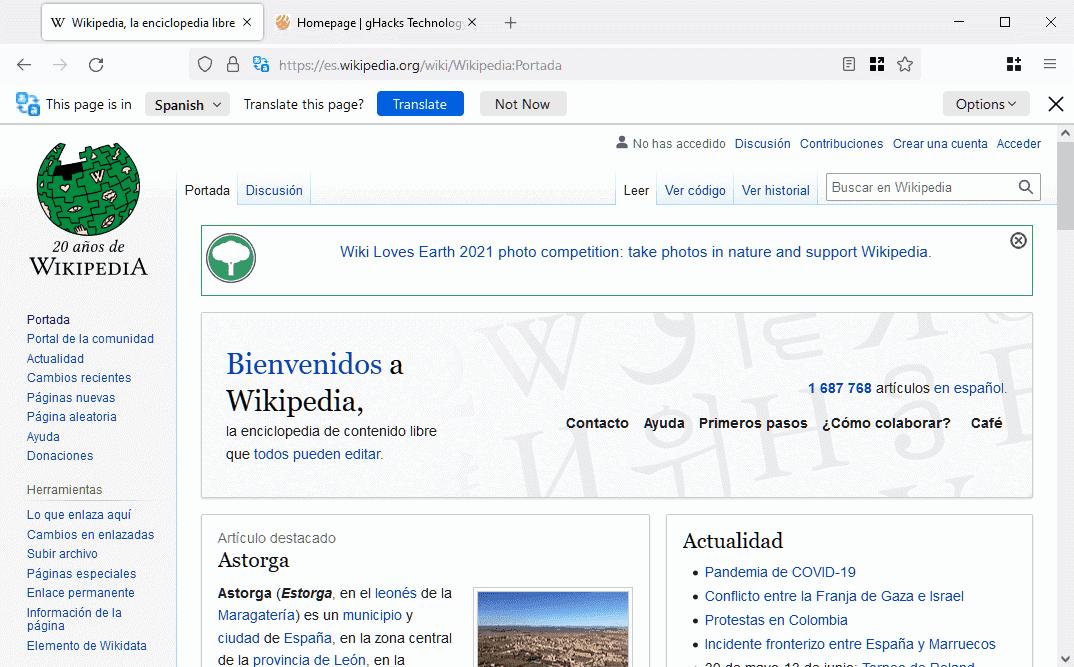
Firefox, as a world-renowned browser, has a self-developed kernel. Previously, it did not have a self-developed translation function. Instead, users need to install extensions such as Google Translate. Recently, Mozilla announced the launch of Firefox Translations, a self-developed translation tool for Firefox. Unlike conventional translation tools, the translation function of Firefox Translations is completed locally in the system to protect user privacy.

Firefox

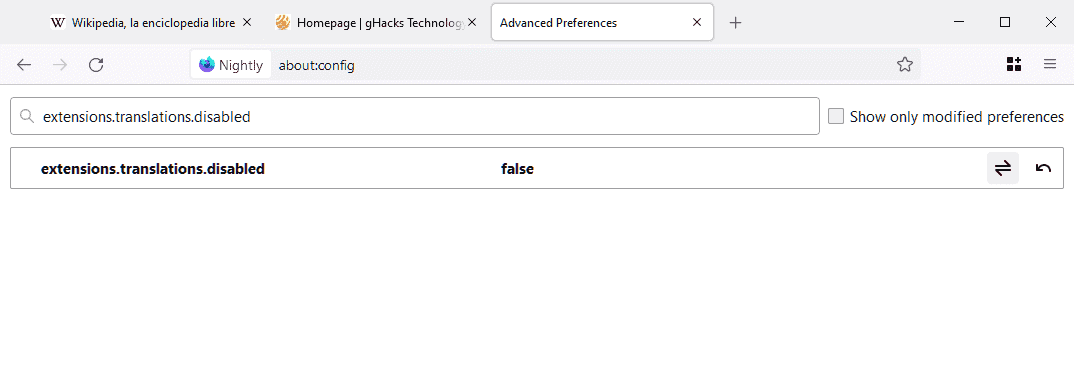
Mozilla officially stated that Firefox Translations has been officially launched in the  Firefox Nightly version. However, users of this browser will need to manually turn it on :

  • Enter about: config in the Firefox address bar;
  • Search for extensions.translations.disabled;
  • Set the option to false;
  • Just restart the browser.

When Firefox Translations is enabled, a translation button will be displayed at the top of the web page. The function is also relatively complete and you can get a feel of it presently. This latest feature by Mozilla gives users more translation options. Of course, users can still opt to remain with the Google Translate plugin or have both. Whatever the case is, Mozilla promises that its native translation feature brings more security.

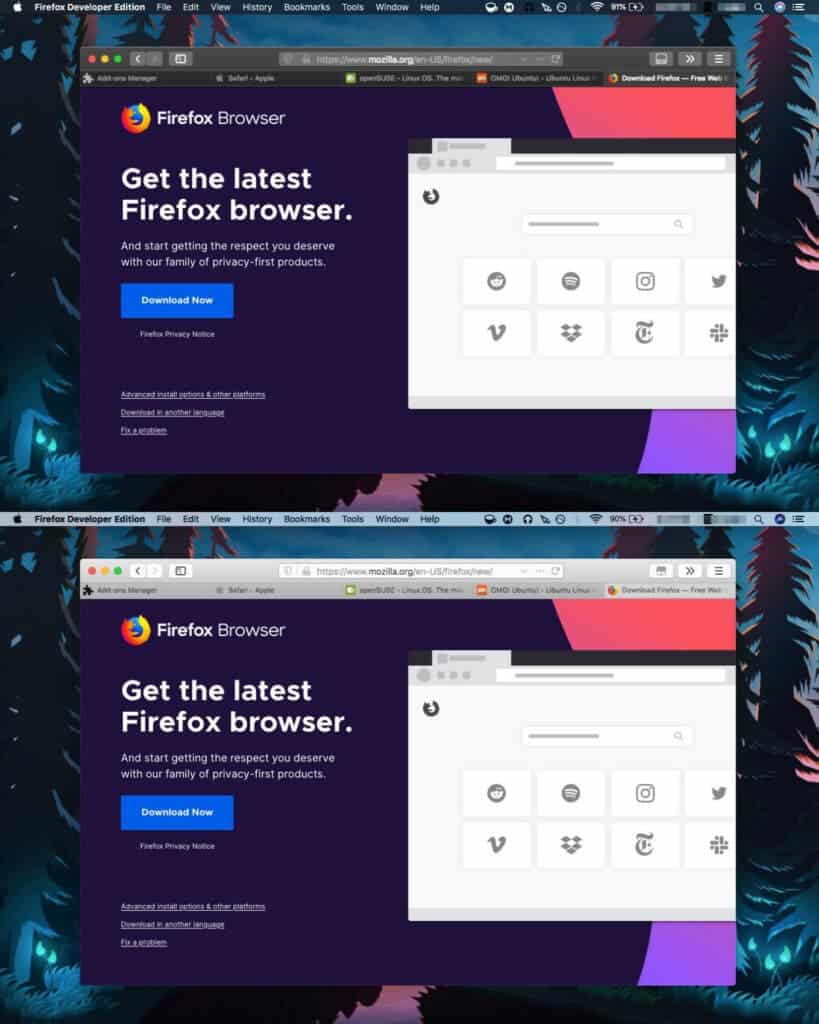
Firefox browser for macOS: optimize dark mode and support native fullscreen

According to the weekly update of Firefox-Nightly, Mozilla is improving some items of the macOS version of the browser to enhance the browser’s native visual effects. The new improvements include

  • Support for the macOS system’s native full-screen
  • Animation effects when the scroll bar hits the bottom and top of the web page
  • Improvements to the dark mode.

According to Mozilla, a new flat scroll bar animation effect has been enabled in Firefox Nightly. However, users need to manually enable the native full screen and enhanced dark mode functions by themselves. If you need to activate the native full screen, you will have to enter “about:config”, then open “full-screen-api.macos-native-full-screen”. To enable the enhanced dark mode, you need to enter “about:config” again, and then open “widget.macos.respect-system-appearance”.

The improvement work on macOS native full-screen support and enhanced dark mode is still in progress. Therefore, users who want to be early adopters may encounter many problems after enabling these features in Firefox Nightly. Users who pursue stability can wait for the official stable version of this browser. The official version of Firefox90 is here. The current version of Firefox90 on the Nightly channel is the beta version (expires on June 1). According to the FX Trains from Firefox, the official version of Firefox90 should be available on July 13, 2021.

Source/VIA :

Microsoft's Team will now feature in-line message translation for IOS and Android devices - PINKVILLA - Translation

The new in-line translation feature from Microsoft Teams will make life easy during meetings with international clients.

Microsoft Teams, Translation Feature, Microsoft's Team will now feature in-line message translation for IOS and Android devices

The world has been working remotely for more than a year now, and we don't have a definite timeline on when we can go back to the old social lifestyle. During these challenging times, along with everything else, our work-life too has evolved. With travel restrictions, most international client meetings get conducted on professional platforms such as Microsoft Teams. One of the principal challenges in such a meeting is the language barrier. Ordinarily, people would keep a translator App handy and keep switching between apps to get a translation. 

Microsoft's Teams will eliminate the hassle of switching between apps. Teams provide an in-line translation that is visible to everyone at the meeting. The feature is currently in development and will allow users to see a translated version of their messages on the team chat. Users wanting to translate a particular chat, have to press and hold the chat to get additional options. Then select translate. By default, the Teams App will translate the chat to the default language of the user's device or the preferred language selected by the user for the Teams app on his device.

This feature will eliminate the need for an additional app for translation, and there will be fewer interruptions in the meeting.

The Education industry also stands to gain much from the new feature. Teachers will not have to pause class to explain/translate to an individual or a group of individuals during an international session that is in progress. 

 Microsoft is currently developing the feature for their existing Desktop App and will simultaneously develop the Apps for IOS and Android. Microsoft Teams translation feature for your Android and IOS device should be ready to use by July this year. We might see the translation feature going live on the Desktop App before the mobile app. 

What is Microsoft Teams?
Microsoft Teams is a workspace chat and videoconferencing tool. Also used for file storage, and application integration.

How to use the Translate feature on Microsoft Teams?
Users wanting to translate a particular chat, have to press and hold the chat to get additional options. Then select translate. By default, the Teams App will translate the chat to the default language of the user's device or the preferred language select

When will the Translate feature be available to users?
Microsoft Teams translation feature for your Android and IOS device should be ready to use by July this year. We might see the translation feature going live on the Desktop App before the mobile app.

You may like these

Your comment has been submitted to the moderation queue